
Parking Lot Markings
When should you change your parking lot markings instead of repainting them?
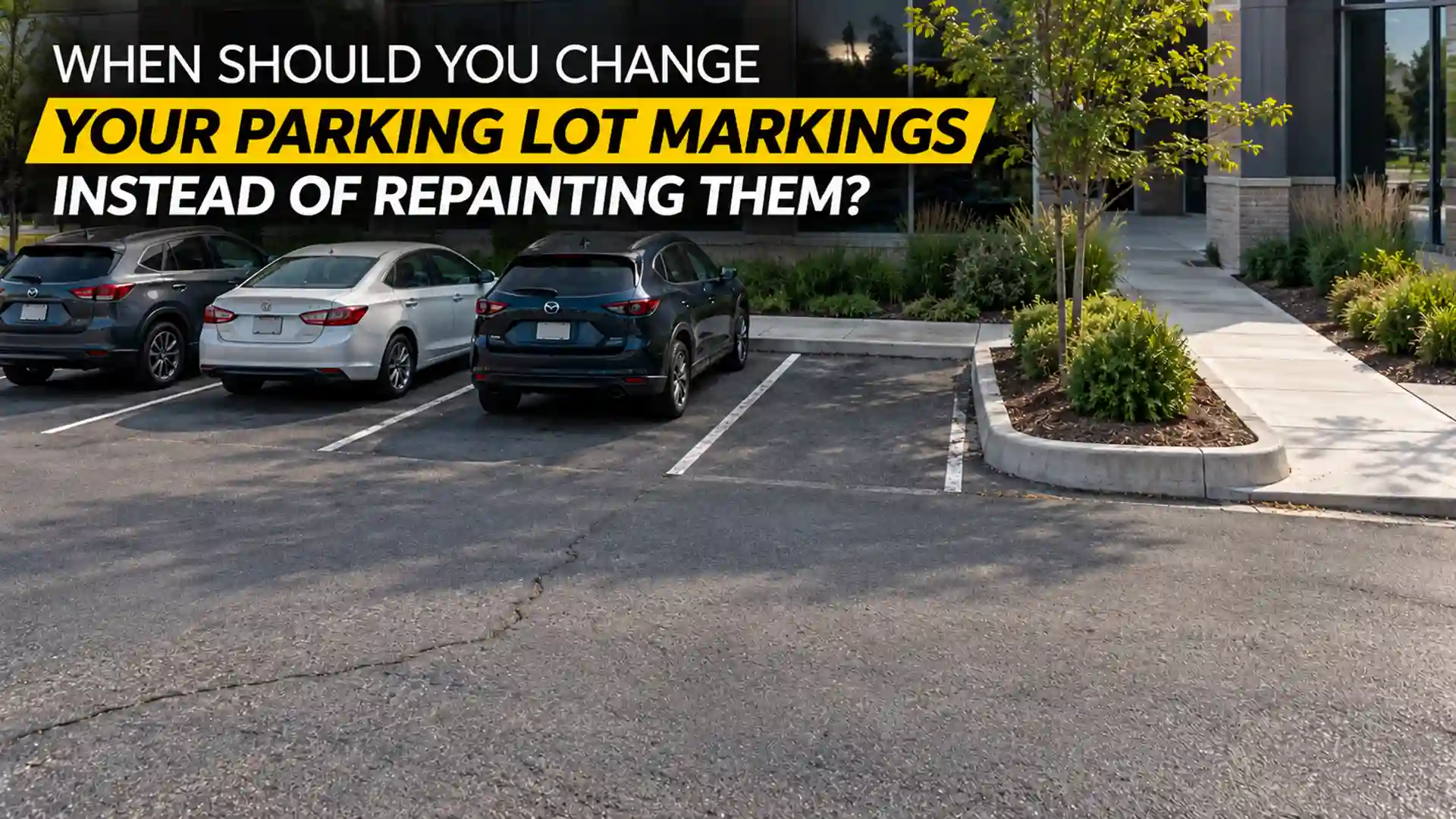
You should repaint parking lot markings when the existing layout still works and only the paint has faded. Consider changing the layout when parking requirements, loading arrangements, vehicle routes, or designated spaces no longer match how your property operates. Reviewing these conditions before painting helps avoid spending money on markings that may need to be replaced.
For property owners planning Parking Lot Marking in Oshawa, the first decision is whether to restore the existing arrangement or change it. Easy Line Marking provides parking lot repainting and new layout services for private commercial properties.
How do you know if repainting is enough?
Repainting is generally appropriate when parking spaces, directional arrows, and designated areas remain correctly positioned but have become difficult to see.
Walk through your parking lot and review whether drivers can still recognize individual spaces and follow the intended vehicle routes.
Consider whether the current arrangement provides suitable parking for customers, employees, and other property users.
If the layout continues to meet these requirements, refreshing the existing markings may be sufficient.
For example, an office property may have faded parking stall boundaries while its parking arrangement remains unchanged. Repainting those boundaries could restore visibility without requiring a new design.
Before approving the work, confirm that the existing lines are suitable for reuse rather than assuming every old marking should be repainted.
What property changes may require a new layout?
A parking arrangement that worked several years ago may no longer suit the property's current requirements.
Changes worth reviewing include:
- New tenants: Different businesses may have different customer, employee, or delivery parking needs.
- Loading requirements: Regular deliveries may require a designated loading area or changes to nearby parking spaces.
- Vehicle movement: Changes to entrances, exits, or internal travel routes may affect directional markings.
- Parking demand: A change in how spaces are allocated may require a layout review.
- Pedestrian movement: New or changed walking routes may affect where pedestrian markings are appropriate.
- Pavement changes: Resurfacing or property alterations may require markings to be measured and established again.
These changes do not automatically require a complete redesign.
The important question is whether the existing markings still represent how the parking area should function.
Can you change only one section of the parking lot?
Yes. A partial layout adjustment may be practical when the required changes are limited to one area and do not create problems elsewhere.
Consider a hypothetical commercial property in Oshawa where a section previously used for customer parking is now needed for regular deliveries.
Repainting the existing stalls would preserve an arrangement that no longer meets the property's needs.
Instead, the property manager could review the required loading space, vehicle access, and nearby parking boundaries.
If the changes can be accommodated within that section, the remaining parking layout may not need to be redesigned.
However, adjustments to one area can affect adjoining travel aisles, parking capacity, or pedestrian routes.
Easy Line Marking can review the proposed changes and discuss the marking work required.
A partial adjustment should be based on the complete arrangement, not simply the area where new paint will be applied.
What happens to outdated parking lot markings?
Old markings can become a problem when they remain visible alongside a new arrangement.
For example, if parking stalls are repositioned but their previous boundaries remain recognizable, drivers may encounter conflicting visual information.
Before approving a revised layout, ask how the existing markings will be addressed.
The appropriate approach depends on the pavement, condition of the old paint, and proposed new markings.
Do not assume that painting new lines over an existing arrangement will make every outdated marking disappear.
If the project involves removing, covering, or otherwise treating previous markings, confirm whether that work is included in the quotation.
For Parking Lot Marking in Oshawa, clarifying this requirement before painting can help prevent an incomplete scope.
What affects the cost of changing parking markings?
Changing a parking layout can involve different work from repainting existing lines.
The cost depends on the amount of marking required, layout measurements, pavement condition, preparation, and access restrictions.
The main considerations include:
- | Cost factor | Why it matters
- | Layout measurements | New parking arrangements may require additional planning and positioning
- | Existing markings | Outdated lines may need separate treatment
- | Number of markings | More stalls, arrows, and designated areas increase the scope
- | Surface condition | Cleaning or other preparation may be necessary
- | Operational access | Occupied parking areas can affect scheduling
- | Project size | Larger or more complex changes may require additional coordination
A partial redesign is not automatically cheaper than repainting a larger section because the work may involve additional layout planning and treatment of previous markings.
When comparing quotations, make sure the proposed scope clearly identifies both the markings being added and any existing markings being changed.
Easy Line Marking can review the relevant project requirements before preparing an estimate.
What should you check before approving a new layout?
Before approving a revised parking arrangement, review how the proposed markings will affect everyday use.
Start with parking capacity. Determine whether the revised layout provides the required number and types of spaces.
Next, review vehicle movement. Drivers should be able to understand the intended routes without encountering conflicting directional information.
Consider whether loading vehicles have appropriate access and whether pedestrian routes remain practical.
Also review designated areas, including accessible parking spaces and other markings relevant to the property.
Where accessibility, fire routes, or other regulated requirements apply, the proposed arrangement should be checked against applicable official requirements.
A new layout should not be considered compliant simply because the markings have been professionally painted.
The goal is to confirm that the arrangement is suitable before the paint is applied.
Should pavement repairs happen before changing the markings?
If pavement repairs or resurfacing are planned, coordinate those activities with the marking project.
Painting a new arrangement immediately before resurfacing could result in unnecessary duplicate work.
Surface condition also matters when deciding how to treat existing markings and apply new paint.
Easy Line Marking uses waterborne traffic paint and solvent-based traffic paint for suitable projects.
The appropriate material depends on the pavement, application conditions, and project requirements.
Before scheduling, ask whether the surface needs cleaning, whether repairs should be completed first, and which paint is proposed.
Do not assume that every marking material will perform identically under different traffic and weather conditions.
How should you prepare for a layout change?
You can begin planning without having a completed technical drawing.
Prepare the property address, recent photographs, approximate dimensions, and any existing parking layout drawings.
Identify which markings should remain and which areas need changes.
Explain the reason for the proposed adjustment.
For example, stating that delivery vehicles need additional manoeuvring space provides more useful information than simply requesting new arrows or parking boundaries.
Also mention whether the property must remain open during the work.
Depending on the layout, phased painting or lower-activity scheduling may be worth discussing.
Easy Line Marking can assess the existing arrangement, surface condition, and operational requirements before determining the proposed marking scope.
What should you inspect after the work is completed?
Once the painted areas are ready for use, compare the completed markings with the agreed layout.
Check whether parking stall boundaries follow the intended positions and whether directional arrows match the planned vehicle routes.
Confirm that designated areas have been marked as specified.
If previous markings were supposed to be removed or treated, review whether they still create conflicting visual information.
Also verify that any changes to parking allocation or vehicle movement have been communicated to relevant tenants, employees, or property users.
A completed project should leave the intended parking arrangement understandable rather than introduce uncertainty.
Choose the right approach before repainting
Faded parking lines do not always mean the property needs a new layout. Likewise, an outdated arrangement should not automatically be repainted simply because its boundaries are still visible.
The correct decision depends on how the property is currently used and whether the existing markings remain suitable.
For commercial property owners considering Parking Lot Marking in Oshawa, reviewing parking requirements, vehicle routes, designated areas, and pavement conditions before painting can help establish the appropriate scope.
Easy Line Marking provides Parking Lot Repainting and new layout services for private commercial properties in Oshawa.
Contact Easy Line Marking to discuss your parking lot marking requirements and request a quote.
Phone: (437) 577-3547
Email: info@easylinemarking.ca
Ready to Get Started?
Request a free, no-obligation quote and our team will get back to you within one business day.
- Free on-site assessment — no obligation
- Fast response — usually within 1 business day
- Work scheduled around your business hours


