
Commercial Property
When does a pavement marking project need more planning than paint?
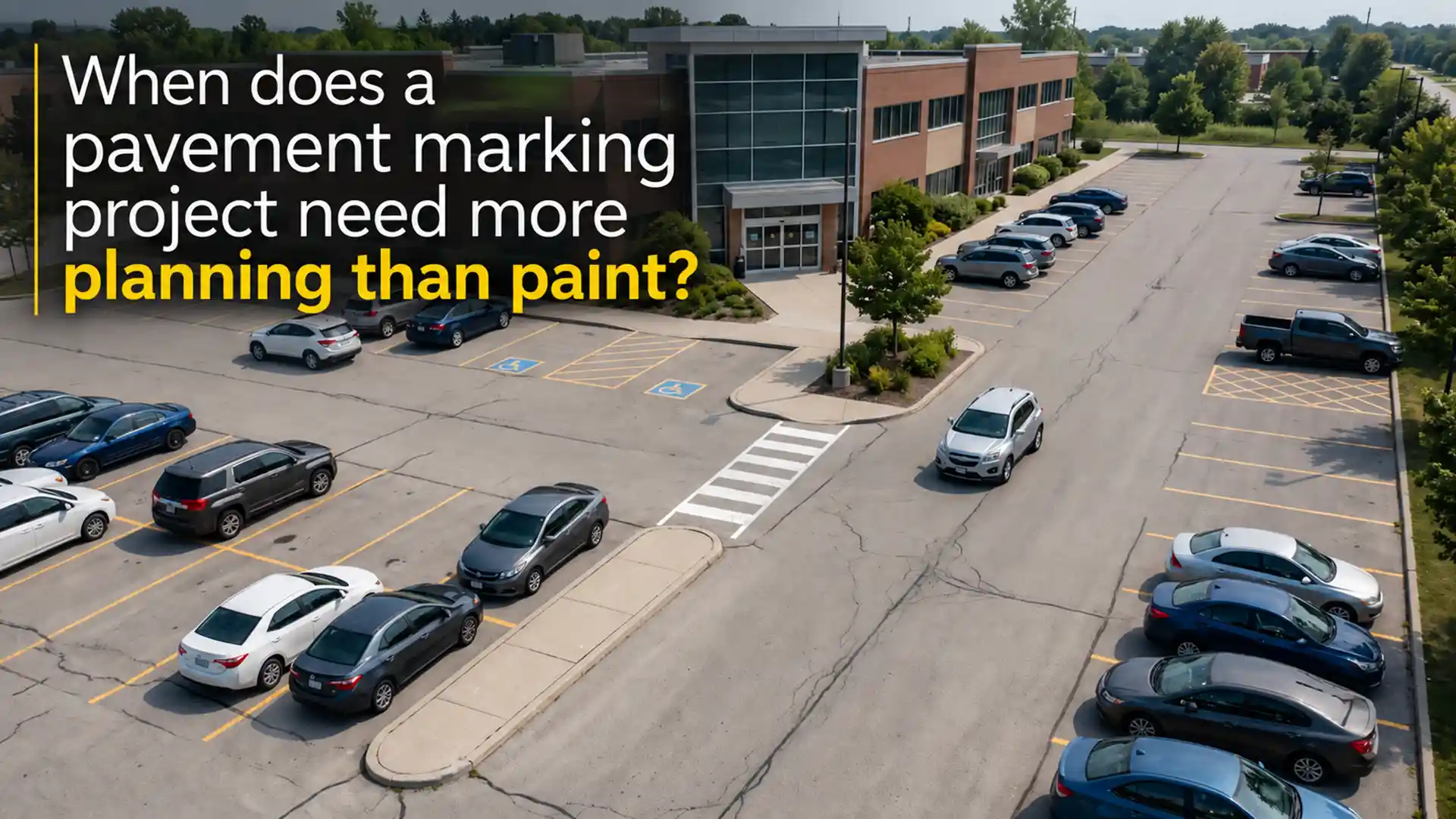
A pavement marking project can begin with a very simple observation: the existing lines are no longer easy to see. But once a property manager looks more closely, other questions can appear. Has the way people use the property changed? Are certain areas busier than they used to be? Does the existing layout still communicate what it is supposed to?
Easy Line Marking looks at these questions before determining what the property actually needs. For businesses considering Commercial Pavement Marking in Pickering, the important decision is not simply how much pavement needs paint. It is whether the existing arrangement still makes sense for the property today.
That difference can influence the entire project.
Start with the decision, not the application
There are several reasons a property may need new or refreshed markings. Existing lines may have faded, a new area may need to be organised, or an established layout may no longer reflect current operations.
Those situations can look similar from a distance.
Easy Line Marking can assess the property and distinguish between repainting an existing layout and developing a new arrangement. That gives the property manager a clearer basis for deciding what should actually happen.
Look at what the property has become
Commercial properties rarely stay exactly the same.
Tenants change, traffic patterns evolve, customer volumes fluctuate, and delivery activity can become more frequent. Even a property that has not undergone major construction can gradually develop a different pattern of use.
Before Commercial Pavement Marking in Pickering is planned, consider whether the current markings were designed for the way the property operates now.
A layout doesn't become unsuitable simply because it is old. It becomes worth reviewing when the conditions around it have changed.
Use behaviour as evidence
Sometimes the people using the property reveal problems without saying anything about them.
Drivers may repeatedly choose certain routes. Pedestrians may naturally cross at a particular location. Vehicles may gather around one entrance, while another area remains largely unused.
These patterns are worth observing before making assumptions.
Easy Line Marking can consider traffic flow and operational requirements during a site assessment, helping connect what people are doing with what the pavement markings are intended to communicate.
Separate permanent patterns from temporary ones
Not every unusual activity deserves a permanent marking.
A delivery may temporarily occupy an area. Materials may be staged differently during a busy period. A vehicle may be parked somewhere unusual because of a one-off circumstance.
The important question is whether the pattern keeps happening.
For Commercial Pavement Marking in Pickering, recurring behaviour is generally more useful when deciding whether a marking or layout change deserves consideration. A single unusual event shouldn't automatically dictate a permanent change to the property.
Consider the marking as information
A line isn't valuable simply because it is visible.
It should communicate something useful to the person seeing it. Depending on the property, markings may help define parking areas, traffic movement, pedestrian routes, loading areas, storage boundaries, or other designated spaces.
Easy Line Marking considers the purpose of the markings as part of the planning process. This helps prevent a project from becoming an exercise in adding lines without considering how those lines relate to one another.
Look at the surface separately
The pavement itself needs attention before the marking application.
Dirt, dust, debris, loose material, and moisture can affect preparation. Confirmed preparation used by Easy Line Marking can include cleaning dirt, dust, and debris, removing loose materials, ensuring the surface is dry, measuring the areas to be marked, and using masking or chalking guide lines where required.
The preparation should reflect the actual site condition.
That means the property should be assessed rather than assuming that every marking project requires exactly the same preparation.
Consider what happens during the busiest period
A quiet property can make almost any layout appear functional.
The real test often comes when customers arrive, employees are moving around, deliveries take place, or several vehicles use the same area at once. That's when unclear routes, crowded areas, or difficult access points become more apparent.
Property managers considering Commercial Pavement Marking in Pickering should therefore think about the property's busiest recurring periods rather than judging the layout only when activity is low.
Easy Line Marking can factor operational requirements into the project discussion.
Don't make the entire property part of the problem
One faded section doesn't necessarily mean every marking needs to be changed.
A property may have a large number of markings that still function perfectly well while one area has become difficult to use. Treating everything as a single problem can create unnecessary changes.
A more focused review separates areas that work from areas that need attention.
Easy Line Marking can assess the existing layout and determine whether the project is better suited to repainting, new layout design, or a combination based on the property's requirements.
Ask what will happen around the work
The project itself has to fit into the property's daily activity.
A commercial site may have customer access, employee parking, scheduled deliveries, or other operational requirements that cannot simply stop while markings are completed. Where appropriate, Easy Line Marking can consider phased scheduling or lower-activity periods to help accommodate the property's operation.
The exact schedule depends on the project.
The important point is that timing should be considered before work begins rather than after the marking plan has already been established.
What should a property manager bring to the discussion?
The initial conversation doesn't require a technical drawing.
Useful information can include:
- Property address and project location
- Approximate dimensions
- Recent photographs
- Google Maps or satellite imagery
- Existing layout, if available
- Surface type
- Areas requiring attention
- Whether the project involves repainting or a new layout
- Preferred project timeline
This information gives Easy Line Marking useful context before the site assessment and can make the discussion around Commercial Pavement Marking in Pickering more specific.
Look for reasoning in the recommendation
A useful contractor assessment should explain the thinking behind the proposed work.
At Easy Line Marking, site inspections are typically carried out by an experienced estimator or project manager who evaluates the property's layout, existing markings, traffic flow, surface condition, and project requirements before recommending an appropriate approach.
That gives a property manager something more valuable than a list of areas to paint.
It explains why those areas have been identified in the first place.
The strongest test is simple
Imagine the pavement markings disappeared tomorrow.
What information would people suddenly struggle to understand?
That question can help identify which markings are genuinely important to the property. It shifts the conversation away from paint coverage and toward communication.
For Commercial Pavement Marking in Pickering, that is a useful way to think about the project. The objective isn't to maximise the number of markings. It is to make the necessary information clear.
Easy Line Marking can help evaluate that distinction during the assessment process.
A better project starts with better questions
Before approving the work, ask whether the current layout still matches the property, which markings are genuinely important, whether observed traffic patterns are recurring, and whether the surface is ready for the proposed work.
Then consider whether repainting is enough or whether a different arrangement deserves attention.
Easy Line Marking can assess the site and discuss the appropriate approach based on its current condition and operational requirements.
The practical takeaway
Good Pavement Marking begins with understanding what the property needs the markings to communicate.
If the layout still works, refreshing it may be all that is necessary. If the property has changed, a closer review may reveal that certain areas need adjustment rather than simply brighter paint.
For Commercial Pavement Marking in Pickering, the most useful starting point is therefore the property itself.
Easy Line Marking can be contacted at +1 437-577-3547 or info@easylinemarking.ca to discuss a project and arrange the appropriate assessment.
Ready to Get Started?
Request a free, no-obligation quote and our team will get back to you within one business day.
- Free on-site assessment — no obligation
- Fast response — usually within 1 business day
- Work scheduled around your business hours


