
No Parking Area
7 no parking zone mistakes that create unnecessary problems
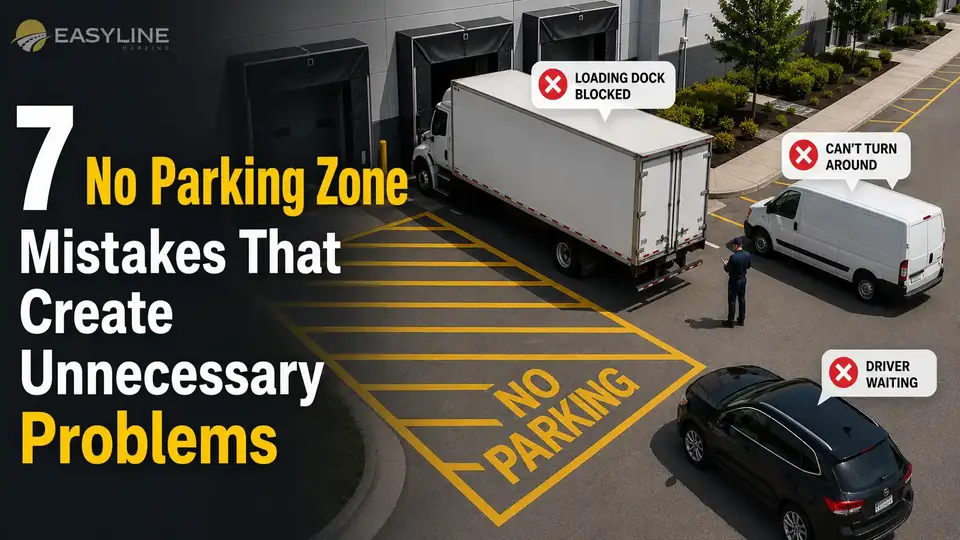
A no parking zone should never leave room for interpretation. Whether it's protecting a fire route, loading dock, service entrance, or emergency access lane, the purpose is simple—keep critical areas available when they are needed.
Yet many commercial properties experience the same parking issues repeatedly. Visitors stop in restricted areas, delivery vehicles lose access, and staff spend valuable time asking drivers to move. In our experience at Easy Line Marking, these situations are rarely caused by careless drivers alone. They often result from unclear visual communication.
The following are seven of the most common mistakes property managers make and practical ways to avoid them. Proper No Parking Area Marking is often the difference between a parking lot that works smoothly and one that creates daily frustration.
Mistake 1: Assuming every driver knows where they cannot park
People visiting a property for the first time don't understand its daily operations.
A delivery entrance may look like extra parking. A fire route may appear wide enough for temporary stopping. A maintenance access lane might seem unused during certain hours.
Instead of expecting visitors to understand the layout, make the pavement communicate clearly. Highly visible markings remove guesswork before drivers make parking decisions.
Easy Line Marking recommends evaluating restricted areas from a visitor's perspective rather than an employee's.
Mistake 2: Waiting until the markings have almost disappeared
Many properties postpone repainting until markings become extremely difficult to see.
Unfortunately, parking behaviour usually changes much earlier.
As paint gradually fades, drivers become less certain about where restrictions begin and end. Parking habits slowly change, and before long, the same operational problems occur every week.
Refreshing No Parking Area Marking before visibility becomes poor is usually more effective than reacting after complaints begin.
Mistake 3: Treating every restricted zone the same
Every restricted area serves a different purpose.
A loading dock needs space for large delivery vehicles. Fire routes require immediate emergency access. Waste collection points need room for service vehicles. Equipment areas should remain free from visitor traffic.
Applying identical markings everywhere often reduces clarity instead of improving it.
Easy Line Marking believes every restricted area should reflect its operational function so drivers immediately understand why the space must remain clear.
Mistake 4: Depending only on signs
Signs are important, but they are not the first thing drivers notice.
Most people entering a commercial property focus on traffic, pedestrians, parking spaces, and the pavement directly ahead. Ground markings guide behaviour much faster than wall-mounted signs.
The best commercial properties combine clear signage with visible pavement markings so both systems reinforce each other.
This balanced approach makes No Parking Area Marking significantly more effective while reducing confusion throughout the property.
Mistake 5: Forgetting that the property changes over time
Commercial properties rarely operate exactly as they did five years ago.
New tenants move in. Delivery schedules increase. Parking demand changes. Service areas expand. Electric vehicle charging stations are added. Operational priorities evolve.
Unfortunately, pavement markings are often left exactly where they were originally painted.
Easy Line Marking recommends reviewing restricted parking areas every year to ensure they still support current traffic patterns instead of outdated layouts.
Mistake 6: Looking only at parked vehicles instead of traffic movement
Many property managers evaluate parking problems by counting how many vehicles stop in restricted areas.
A better question is how those vehicles affect the entire property.
Does a parked vehicle block deliveries?
Does it reduce visibility at an intersection?
Does it interfere with emergency access?
Does it force pedestrians into vehicle lanes?
Looking at overall traffic movement often reveals problems that are much larger than a single improperly parked car.
This broader perspective is why No Parking Area Marking contributes to both safety and operational efficiency.
Mistake 7: Waiting for complaints before taking action
One of the biggest mistakes is assuming everything is working because nobody has complained.
Drivers usually adapt.
Employees find alternate routes.
Delivery drivers make temporary adjustments.
Supervisors spend extra time directing traffic.
These workarounds hide the real issue instead of solving it.
Easy Line Marking encourages proactive parking lot inspections rather than reactive maintenance. Small improvements made early often prevent much larger operational challenges later.
Final thoughts
Good commercial parking lots rarely attract attention because they communicate clearly from the moment a vehicle enters the property.
Drivers know where to park, where to stop, and which areas should remain clear without needing constant reminders. That level of organization doesn't happen by chance—it comes from thoughtful planning and regular maintenance.
Through projects completed across Ontario, Easy Line Marking has found that effective No Parking Area Marking improves more than compliance. It supports smoother traffic flow, protects emergency and service access, reduces daily interruptions, and creates a more professional experience for employees, visitors, contractors, and delivery drivers.
Contact Easy Line Marking
Easy Line Marking helps commercial properties create safer, more organized, and more professional environments through clear and durable pavement markings.
Whether you manage a retail plaza, office complex, warehouse, condominium, industrial facility, or commercial property, Easy Line Marking helps improve traffic flow, workplace safety, and operational efficiency with professionally planned Pavement Marking systems.
Phone: (437) 577-3547
Email: info@easylinemarking.ca
Ready to Get Started?
Request a free, no-obligation quote and our team will get back to you within one business day.
- Free on-site assessment — no obligation
- Fast response — usually within 1 business day
- Work scheduled around your business hours


