
Road Marking
Where do road-style markings make sense on a private commercial property?
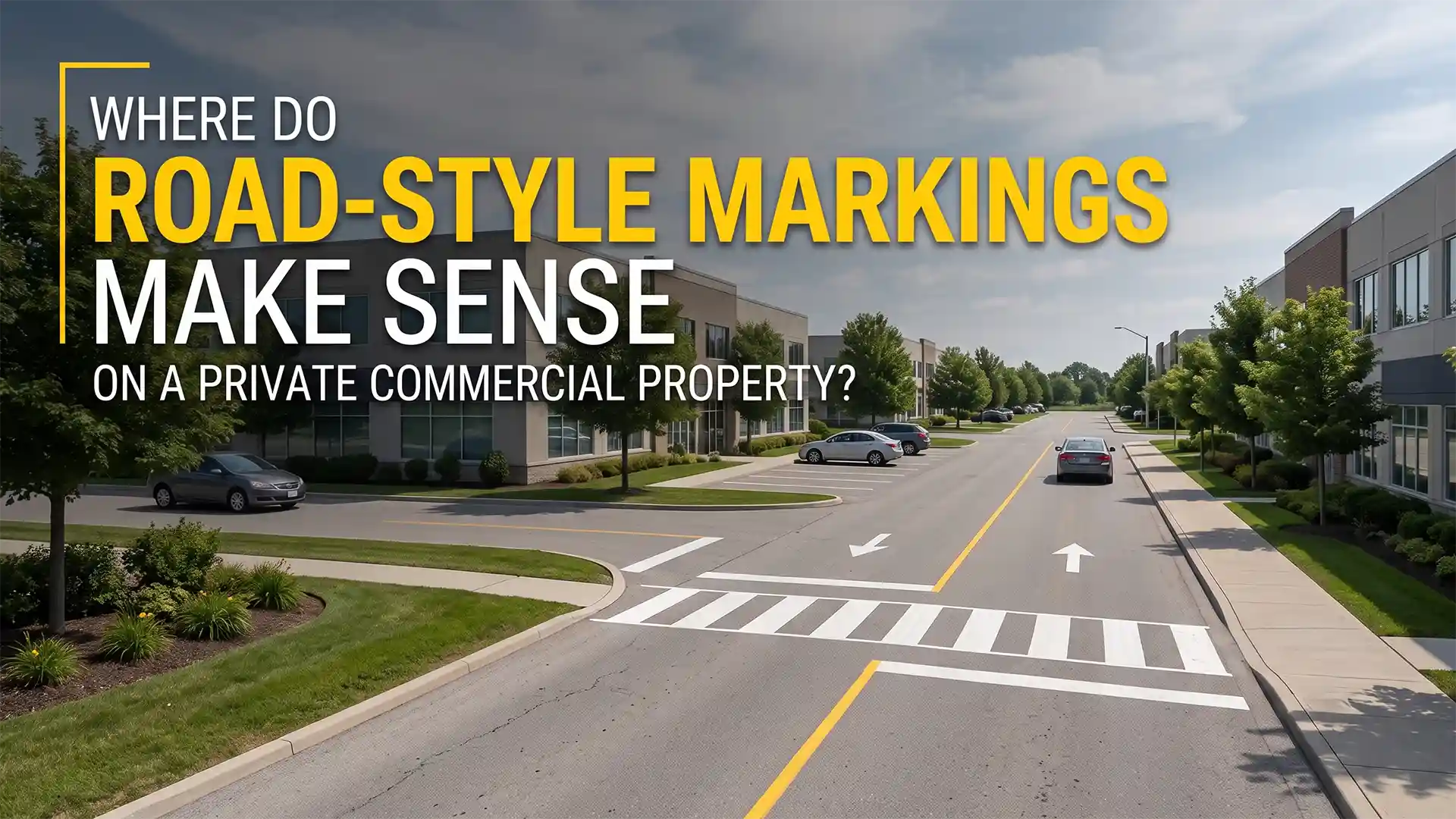
Not every vehicle route is a public street. Large commercial and industrial properties can have privately managed roads and driving areas that connect entrances, buildings, loading areas, parking lots, and other parts of the site.
These spaces create a specific use case for Road Line Painting. For Easy Line Marking, the relevant work is on private commercial properties, not municipal streets or public highways.
The useful question is therefore not simply, “Does this property need road markings?” It is: which private vehicle areas need pavement markings to make their intended use clearer?
When does a commercial property start to feel more like a road network?
A small parking lot may have a relatively simple arrangement. Larger sites can be different.
A vehicle might enter the property and travel some distance before reaching its destination. The route could connect separate buildings, parking sections, service areas, or other parts of a private site.
At that point, the pavement is doing more than providing parking spaces. Part of it is functioning as an internal vehicle route.
Recognizing that difference matters because markings for a travel area serve a different purpose from the lines defining individual parking stalls.
Start at the property entrance
Think about the experience of a driver arriving for the first time.
After leaving the public street and entering private property, what happens next?
On some sites, the parking area is immediately obvious. On others, the driver continues through the property before reaching a parking or operational area.
This transition is where the private site's own pavement layout becomes important.
A property manager considering Road Line Painting can look at the entrance as the beginning of an internal journey. From there, consider what vehicle areas exist and what the pavement needs to communicate as drivers continue through the site.
Follow the route instead of looking at isolated lines
A useful way to review a large commercial property is to follow the same path a vehicle would.
Start at an entrance and move through the private site.
Where does the route lead? Does it continue to one destination or connect several areas? At what point does a travel route become a parking area? Are there separate parts of the property that vehicles need to reach?
This route-based view is different from inspecting individual lines.
It helps property managers understand the relationship between different pavement areas and identify where markings may have a meaningful function within the overall layout.
Private roads and parking lots are not the same space
A parking stall communicates where an individual vehicle is intended to park. An internal driving area serves another purpose: movement through the property.
Large private sites may contain both.
That distinction should remain clear when a pavement marking project is planned. The markings should correspond with what each part of the property is actually used for rather than treating every paved area as one large parking lot.
This is particularly relevant for commercial campuses, industrial properties, office parks, condo roads, and other private sites where vehicles may travel through the property before reaching their destination.
What happens where one type of pavement area meets another?
Some of the most important planning questions occur at transitions.
A private vehicle route may lead into a parking area. Another route may connect different sections of a commercial site. Vehicle areas may also interact with pedestrian areas or other designated spaces.
These locations should be considered as part of the complete property rather than as unrelated pieces.
When planning Road Line Painting, ask what drivers need to understand as they move from one type of area into another.
This helps keep the marking plan connected to the physical journey through the property.
Not every stretch of pavement needs more paint
A large private property can contain substantial paved space. That does not mean every section requires additional markings.
Each proposed marking should have a reason to exist.
Property managers can ask:
- What is this part of the pavement used for?
- Who normally travels through it?
- What does a driver need to understand here?
- How does this area connect with the next part of the property?
- Is a pavement marking actually needed to communicate that purpose?
This prevents the project from becoming a collection of unnecessary painted elements.
The goal is purposeful marking, not maximum paint coverage.
Map the private site before defining the marking scope
For a larger property, it can be useful to think of the site as a simple network.
Identify the entrances first. Then identify the private vehicle routes connecting different areas. Add the parking areas and other relevant destinations.
This does not need to be a technical engineering drawing. Even an existing property plan or satellite view can provide useful context during the early discussion.
Easy Line Marking accepts information such as site photographs, approximate dimensions, existing layouts, property addresses, and Google Maps or satellite views when discussing project requirements.
These materials can help explain how different areas of a private property relate to one another.
When does the property need an on-site review?
A map can show the overall shape of a property, but it cannot answer every marking question.
An experienced Easy Line Marking estimator or project manager can inspect the site to review its layout, existing pavement markings, traffic flow, pavement condition, measurements, accessibility and safety requirements, and operational needs.
This becomes useful when the relationship between different vehicle areas needs to be understood in person.
The assessment can then help establish what Road Line Painting is relevant to the private site and what should actually be included in the project scope.
From layout to pavement
Once the required markings have been identified, the physical pavement still needs to be considered.
Easy Line Marking's confirmed preparation can include cleaning dirt, dust, and debris, removing loose material, ensuring the surface is dry, measuring and laying out the required markings, and using masking or chalk guide lines where needed.
The company uses waterborne traffic paint and solvent-based traffic paint.
The specific approach should reflect the property and surface conditions rather than assuming every private vehicle area requires an identical process.
Keep the public/private boundary clear
The phrase Road Line Painting can easily suggest municipal streets or highways. That is not the focus of this page.
Easy Line Marking's relevant scope is private commercial and industrial property.
That can include privately managed vehicle areas such as:
- Internal commercial property roads
- Industrial site vehicle routes
- Office park driving areas
- Private campus roads
- Condo roads
- Connections between parking areas and other private vehicle zones
Keeping this distinction clear helps property managers determine whether their project fits the service before making an enquiry.
Does your private property need road-style pavement markings?
Start with the way vehicles actually use the site.
If they enter directly into a straightforward parking area, ordinary Parking Lot Markings may address much of the property's requirement. If vehicles continue along internal routes connecting several parts of a larger commercial or industrial property, those driving areas may need to be considered separately.
That is where Road Line Painting on private property becomes a distinct planning question.
Easy Line Marking can review the site, discuss how the private vehicle areas are used, measure relevant sections, and help determine an appropriate marking scope based on the property itself.
To discuss line painting for a private commercial road or internal vehicle area, contact:
Easy Line Marking
Phone: +1 437-577-3547
Email: info@easylinemarking.ca
Ready to Get Started?
Request a free, no-obligation quote and our team will get back to you within one business day.
- Free on-site assessment — no obligation
- Fast response — usually within 1 business day
- Work scheduled around your business hours


