
Parking Lot Markings
Which parking lot markings should be treated as a connected system?
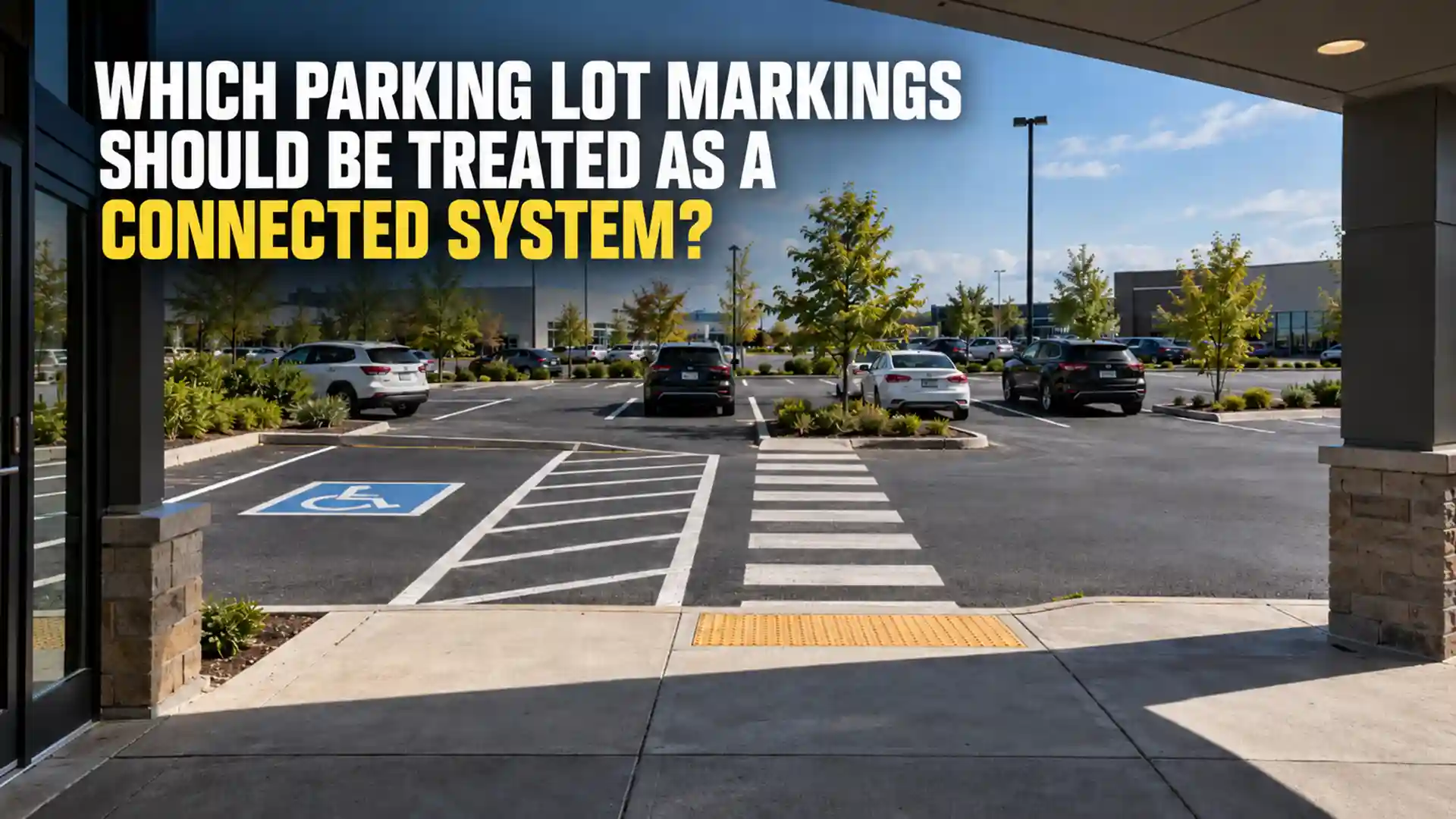
A parking lot contains individual lines, symbols, boundaries, and directional markings, but these elements rarely function independently. A parking stall belongs within a row, a directional arrow relates to a vehicle route, and a pedestrian crossing only makes sense when it connects relevant pedestrian movement across a vehicle area.
For property managers planning Parking Lot Marking in Oshawa, looking at these relationships can help define what the property actually requires. Easy Line Marking works on private commercial properties, providing repainting and new layout design according to the intended use and physical requirements of the site.
A parking stall belongs to a larger row
A single parking stall has boundaries, but those boundaries form part of a wider parking arrangement.
The position of one stall relates to neighbouring spaces and the row in which it sits. This means an individual line should not be considered without understanding the layout around it.
If an existing arrangement is being repainted, the property manager should first establish whether that layout remains suitable. For a newly paved or reconfigured area, a new arrangement may be required.
During Parking Lot Marking in Oshawa, the intended parking layout provides the context for deciding where individual stall markings belong.
Parking rows and travel areas perform different jobs
Parking rows define where vehicles are intended to remain. Adjacent travel areas accommodate vehicle movement through the private property.
These two functions need to relate logically.
A parking row cannot be considered entirely separately from the area vehicles use to approach or leave it. At the same time, vehicle movement markings should not be positioned without considering the surrounding parking arrangement.
This relationship is an important part of Parking Lot Line Painting. The objective is not simply to paint individual elements but to ensure that each included marking corresponds with the intended property layout.
For Parking Lot Marking in Oshawa, understanding adjoining functions helps create a more clearly defined project scope.
A crossing needs a pedestrian route
A painted pedestrian crossing should not exist as an isolated decorative feature.
It should correspond with a genuine pedestrian route that needs to cross an area used for vehicle movement. The connection on either side therefore matters as much as the crossing itself.
Before including a crossing, the property layout should establish where pedestrians are expected to move and why they need to cross the vehicle area at that location.
A Parking Lot Line Painter can then work from the established arrangement when positioning the required markings.
This relationship between route and crossing is a good example of why parking lot markings should be planned according to function rather than appearance.
Directional arrows need something to direct
An arrow only provides useful information when it relates to an intended vehicle movement pattern.
Adding arrows simply because a section of pavement is open can introduce markings without a defined purpose. Their placement should correspond with the private property's established vehicle routes.
For Parking Lot Marking in Oshawa, this means directional elements should be considered together with the areas they are intended to guide.
The same principle applies to stop bars and other applicable traffic-related markings on private property. Their inclusion should be based on the site's actual requirements rather than a standard collection of markings applied to every parking lot.
Loading areas connect with surrounding activity
Some commercial parking properties also contain loading or operational sections.
These areas may interact with vehicle travel, pedestrian access, or other designated spaces. Their boundaries should therefore reflect both their own purpose and their relationship with the surrounding pavement.
A loading-related marking should not simply become another parking boundary because it sits beside a parking row.
This is where Parking Lines Painting requires attention to the purpose of adjoining areas. Different markings can belong to the same overall layout while communicating different functions.
During Parking Lot Marking in Oshawa, identifying those relationships helps determine which markings belong in the project.
Existing paint needs a current reason to remain
Old pavement markings provide information about how a parking lot was previously arranged, but that does not automatically mean every old marking should be reproduced.
The relevant question is whether the existing marking still corresponds with the property's intended layout.
Easy Line Marking can repaint existing arrangements or design new layouts for applicable projects, including newly paved surfaces and parking lot reconfigurations.
If the property's needs have changed, the marking plan may need to change as well.
For Parking Lot Marking in Oshawa, an existing line is useful as a reference only when it remains relevant to the current project requirements.
Connect the plan to the physical property
Once the relationships between parking areas, movement routes, pedestrian connections, and other designated sections are understood, their positions need to be established on the actual property.
Easy Line Marking site inspections are typically performed by an experienced estimator or project manager. The assessment may include reviewing the layout and existing markings, taking relevant measurements, examining pavement conditions, and considering accessibility, safety, and operational requirements.
This information helps translate the intended arrangement into a defined marking scope.
The required positions can then be measured and laid out. Masking or chalk guide lines may be used where necessary before application.
For Parking Lot Marking in Oshawa, this stage connects the planned relationships with real positions on the pavement.
Preparation comes after the layout is understood
Once the markings and their positions have been established, the pavement can be prepared for application.
Easy Line Marking's confirmed preparation may include cleaning dirt, dust, and debris, removing loose material, and ensuring the surface is dry.
The company uses waterborne traffic paint and solvent-based traffic paint according to the project requirements and site conditions.
Surface preparation supports the physical painting process, but it does not determine where the markings belong. Those decisions should already be established through the layout and scope.
Keeping planning and application distinct helps ensure that the painting work follows a defined arrangement.
Review relationships, not just individual lines
After a parking lot has been marked, individual lines should make sense as parts of the complete property layout.
Parking stalls should relate to their rows. Rows should correspond with surrounding vehicle movement areas. Crossings should connect genuine pedestrian routes, while arrows and other applicable directional markings should correspond with the movements they are intended to communicate.
This connected perspective gives property managers a practical way to think about Parking Lot Marking in Oshawa without treating every painted element as a separate project.
Easy Line Marking can assess private commercial parking areas, review existing or proposed arrangements, establish relevant measurements, and determine an appropriate marking scope.
For businesses considering Parking Lot Marking in Oshawa, the goal is to make sure each required marking has both an individual purpose and a logical relationship with the property around it.
Contact Easy Line Marking to discuss your parking lot marking requirements.
Phone: +1 437-577-3547
Email: info@easylinemarking.ca
Ready to Get Started?
Request a free, no-obligation quote and our team will get back to you within one business day.
- Free on-site assessment — no obligation
- Fast response — usually within 1 business day
- Work scheduled around your business hours


