
Restricted Access Area
The biggest access control mistake most commercial properties overlook
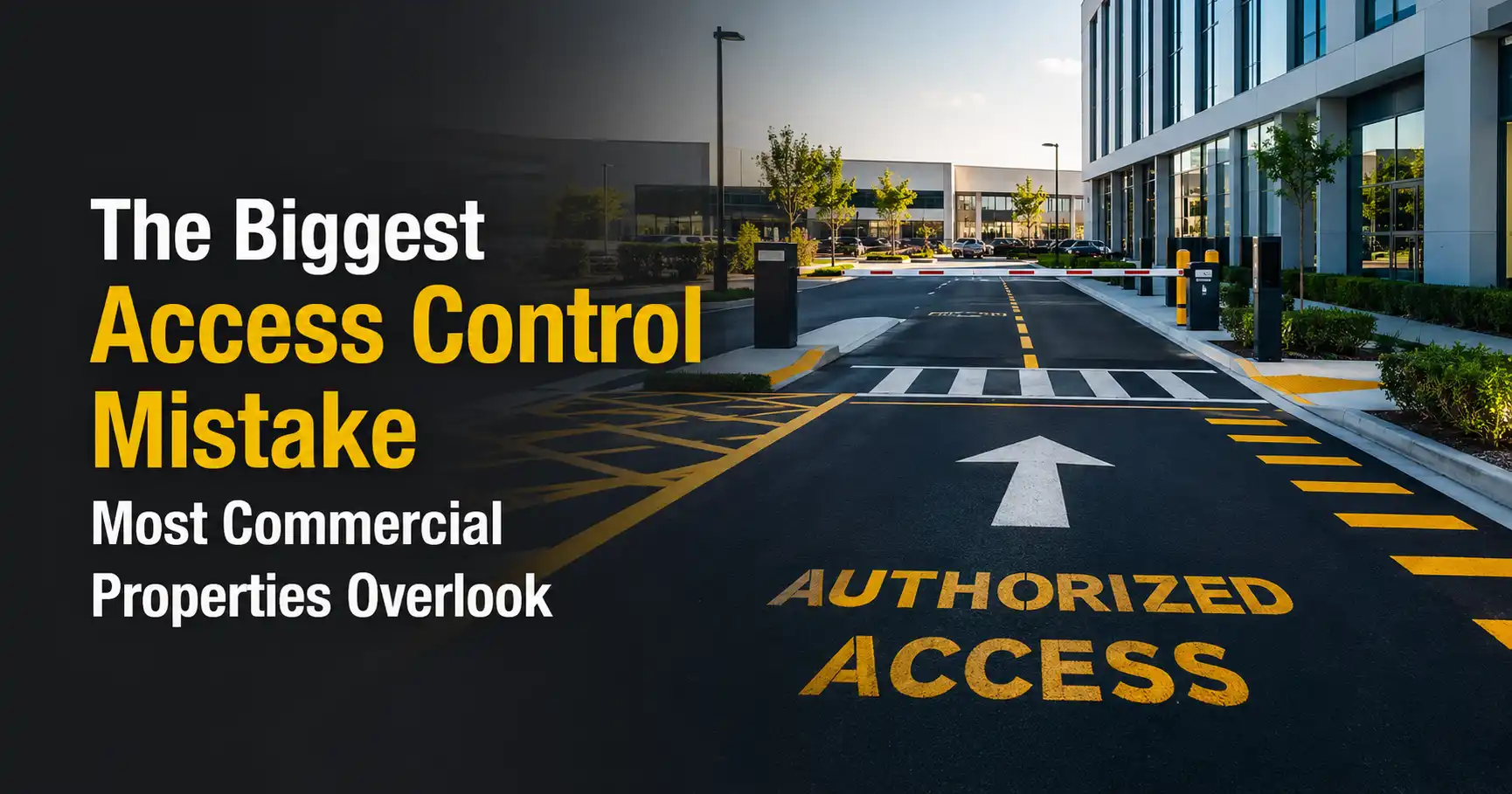
Many commercial properties install warning signs, gates, and barriers to control access, but overlook one of the first things people actually notice—the pavement beneath them. Drivers, contractors, employees, and visitors naturally rely on visual guidance while moving through a property. Easy Line Marking has found that clearly defined pavement boundaries improve decision-making long before someone reads a sign. This is why Restricted Access Area Marking helps businesses strengthen access control, improve traffic flow, and create safer working environments.
Access control starts before someone reaches a gate
Many people assume restricted access begins where a gate or security checkpoint is located.
In reality, access control begins much earlier. Drivers decide where to turn, stop, slow down, or continue based on what they see as they approach an area. If those visual cues are weak, uncertainty increases.
Easy Line Marking regularly works with commercial and industrial properties where security measures are in place, yet visitors still enter operational areas unintentionally. In many cases, the issue is not poor security. The issue is that the pavement provides little guidance before drivers reach the restricted zone.
Well-planned markings prepare people to make the correct decision before they arrive at the restriction itself.
Every restricted area should have a clear purpose
Not every restricted space exists for the same reason.
Some protect employees working around heavy equipment. Others keep delivery vehicles away from customer parking. Maintenance compounds, loading docks, emergency access routes, utility areas, and storage yards all require different levels of access control.
Easy Line Marking encourages property managers to think beyond painted lines. Every restricted area should clearly communicate why it exists through its layout and visibility.
When operational zones are easy to understand, people naturally respect them because the purpose becomes obvious without additional explanation.
Many Restricted Access Area Marking projects begin during broader site reviews where businesses want to improve both safety and workplace organization.
The cost of unclear boundaries is often hidden
Access problems rarely begin with major incidents.
More often, they appear as small operational interruptions. Delivery trucks stop in equipment zones. Contractors park where machinery operates. Visitors enter service roads while searching for reception.
Each event may seem minor, but together they slow operations, distract employees, and create unnecessary safety risks.
Easy Line Marking frequently observes that these situations become accepted as part of everyday business because they happen gradually. Businesses often adapt to the problem instead of solving it.
Clear pavement markings help eliminate this uncertainty by guiding people before incorrect decisions are made.
Case study: Improving access around a distribution facility
Problem
A growing distribution facility experienced repeated traffic conflicts near its loading area. Delivery drivers regularly entered forklift operating zones because unloading routes were not clearly separated from restricted workspaces.
Solution
Easy Line Marking studied traffic movement during normal operating hours before redesigning restricted boundaries, directional markings, unloading routes, and equipment access zones.
Outcome
Drivers reached the correct unloading locations more consistently, forklift traffic became easier to manage, and supervisors spent significantly less time redirecting vehicles throughout the day. The property became more organized without requiring structural changes.
Field observation
One observation Easy Line Marking frequently makes is that restricted areas rarely lose effectiveness overnight.
Instead, boundaries slowly become part of the background. Employees begin storing materials just outside marked zones. Vehicles stop slightly beyond designated limits. Temporary activities gradually become permanent.
Because these changes happen over months rather than days, they often go unnoticed until operations become noticeably less efficient.
Regular reviews help identify these gradual shifts before they begin affecting workplace organization or safety.
Contractors and visitors see the property differently
Employees understand where they are allowed to go because they work there every day.
Visitors, contractors, and delivery drivers arrive with no knowledge of the property's layout. They rely almost entirely on what they can immediately see.
Easy Line Marking recommends evaluating restricted areas from the perspective of a first-time visitor. If someone unfamiliar with the property cannot instantly recognize where access changes, the visual guidance may need improvement.
This practical exercise often reveals opportunities to improve navigation without changing fences, gates, or building layouts.
Many Restricted Access Area Marking projects focus on making the property easier to understand rather than making it more restrictive.
Good markings improve operational efficiency
Restricted markings are often associated only with security.
However, they also improve productivity.
Clearly defined operational boundaries help employees keep equipment within designated areas, maintain organized storage, protect emergency access routes, and separate different workplace activities. Less time is spent correcting mistakes because expectations are communicated visually.
Easy Line Marking has found that facilities with well-maintained access markings often experience smoother daily operations because people naturally follow the layout provided to them.
The objective is not simply to prevent unauthorized entry but to help the entire property function more effectively.
Annual reviews keep restricted areas relevant
Commercial properties evolve continuously.
Departments expand, new equipment arrives, traffic patterns change, and service areas are reconfigured. Markings that worked several years ago may no longer reflect current operations.
Easy Line Marking recommends reviewing restricted zones alongside annual property maintenance plans. Loading areas, maintenance yards, service roads, emergency routes, equipment compounds, and operational workspaces should all be evaluated to ensure they still support the way the site functions today.
Many Restricted Access Area Marking projects involve updating layouts rather than simply repainting existing lines.
Conclusion
Effective access control depends on more than gates and warning signs.
People make navigation decisions long before they reach a restricted area, making pavement markings one of the most valuable communication tools on any commercial property. Through projects completed across Ontario, Easy Line Marking has found that Restricted Access Area Marking helps businesses improve workplace safety, traffic management, and operational organization while creating clearer environments for employees, contractors, delivery drivers, and visitors.
FAQ
What is restricted access area marking?
Restricted access area marking uses clearly defined Pavement Markings to identify areas that are limited to authorized personnel, vehicles, or specific operational activities.
Why is restricted access area marking important?
It helps improve workplace safety, traffic control, operational organization, and access management while reducing unnecessary confusion.
Where are restricted access markings commonly used?
They are commonly used around warehouses, loading docks, service roads, maintenance compounds, industrial facilities, distribution centres, retail service areas, and commercial properties.
How often should restricted access areas be reviewed?
Easy Line Marking recommends annual inspections and additional reviews whenever operational layouts, traffic patterns, or site activities change.
Why is Restricted Access Area Marking valuable?
Clear pavement markings help employees, contractors, visitors, and delivery drivers recognize controlled areas quickly while supporting safer and more efficient workplace operations.
Contact Easy Line Marking
Easy Line Marking helps commercial properties create safer, more organized, and more professional environments through clear and durable pavement markings.
Easy Line Marking helps warehouses, industrial facilities, logistics centres, retail properties, and commercial sites improve access control, traffic flow, and workplace organization through practical marking systems designed around real operational needs.
Phone: (437) 577-3547
Email: info@easylinemarking.ca
Ready to Get Started?
Request a free, no-obligation quote and our team will get back to you within one business day.
- Free on-site assessment — no obligation
- Fast response — usually within 1 business day
- Work scheduled around your business hours


