
Restricted Access Area
Why do restricted areas need clear pavement markings instead of more signs?
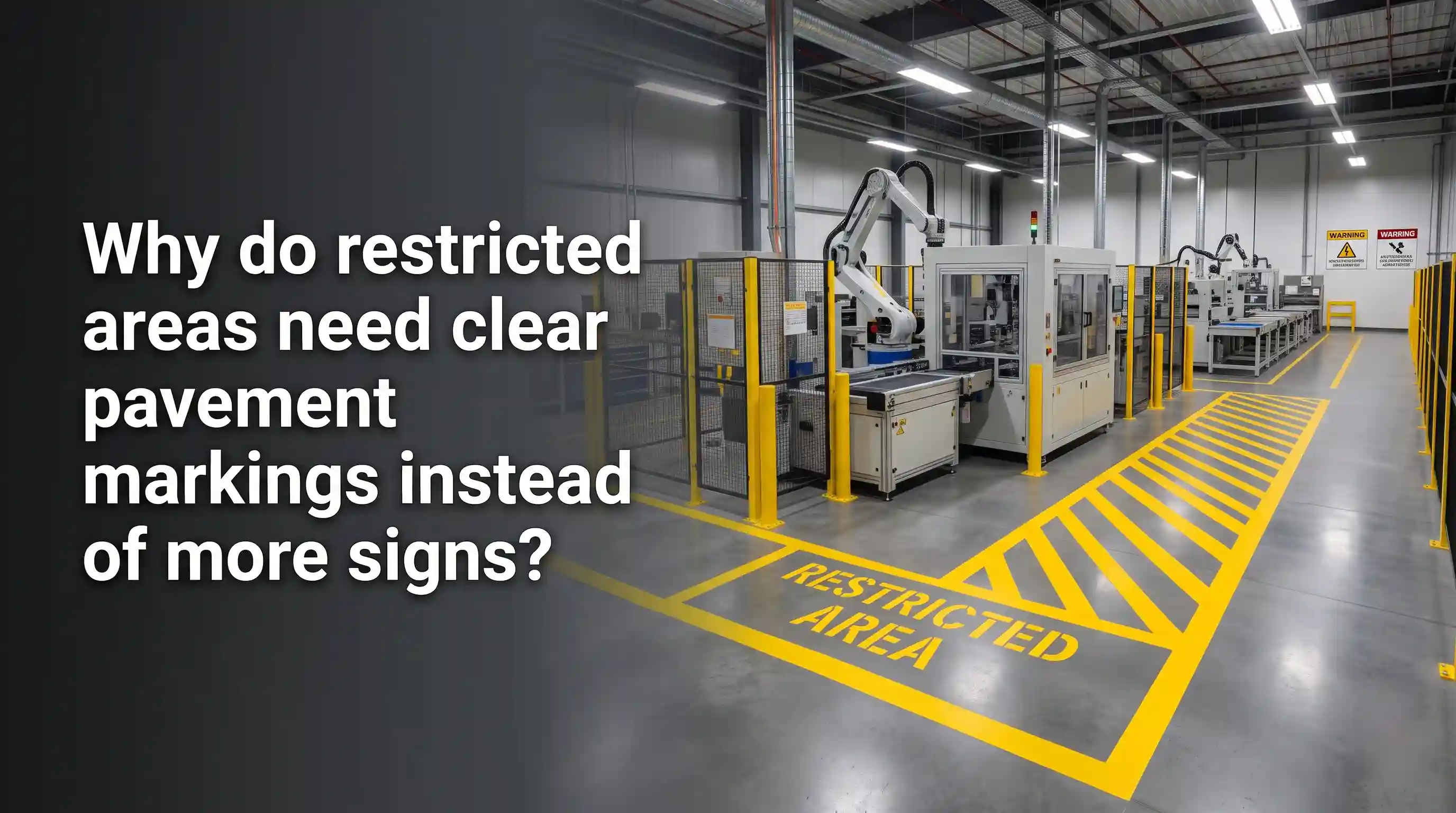
People make navigation decisions long before they read a sign. As they approach a warehouse entrance, loading dock, maintenance yard, or service road, they naturally look at the driving surface for guidance. Easy Line Marking has found that clearly defined pavement markings reduce hesitation and help prevent accidental entry into controlled spaces. This is why Restricted Access Area Marking is widely used to improve workplace safety, support traffic management, and establish clear operational boundaries across commercial and industrial properties.
Clear boundaries reduce uncertainty
Restricted areas are designed to separate activities that should not overlap. Heavy equipment, delivery vehicles, employees, contractors, and visitors often operate within the same property, but not every area is intended for everyone.
Easy Line Marking regularly works with facilities where the physical barriers remain in place while pavement markings gradually lose visibility. Once boundaries become difficult to recognize, people begin relying on assumptions instead of visual guidance.
That uncertainty often leads to vehicles stopping in the wrong place, pedestrians entering equipment zones, or deliveries arriving where they should not.
Signs explain the rule, but markings show the location
A sign can communicate an instruction, but it cannot always define the exact limits of a restricted area.
Ground markings solve that problem by creating an immediate visual boundary. Drivers know where to stop, pedestrians understand where access changes, and contractors can recognize operational zones before entering them.
Easy Line Marking encourages property managers to use signs and pavement markings together because each serves a different purpose. Signs explain restrictions, while pavement markings reinforce them at ground level where people naturally focus their attention.
Many Restricted Access Area Marking projects are completed because existing signs alone no longer provide enough visual guidance.
Every property has areas that require controlled access
Restricted areas are not limited to warehouses or manufacturing plants.
Retail plazas often protect loading zones from customer traffic. Office complexes maintain service corridors for contractors. Condominium communities separate resident parking from maintenance areas. Distribution centres control forklift routes and staging zones.
Easy Line Marking frequently finds that these spaces already function as restricted areas, but the pavement no longer reflects that purpose.
Clearly identifying these operational zones helps everyone understand how the property is intended to function without relying entirely on written instructions.
Case study: Organizing a busy service yard
Problem
A commercial service facility experienced repeated issues with visitors and delivery drivers entering equipment storage areas instead of designated unloading zones. Staff spent valuable time redirecting vehicles throughout the day.
Solution
Easy Line Marking reviewed traffic movement before introducing new boundary markings, directional guidance, and controlled access zones at key decision points across the property.
Outcome
Drivers entered the correct locations more consistently, unauthorized vehicle movement decreased, and operational areas became easier for both employees and visitors to understand.
Field observation
Easy Line Marking frequently observes that restricted areas rarely fail because markings disappear completely.
Instead, the edges slowly become less defined. Vehicles drive slightly beyond the boundary. Materials are placed just outside the designated zone. Over time, those small changes become accepted as normal.
Eventually, the restricted area no longer functions as originally intended.
Maintaining clear pavement boundaries helps reinforce expectations before operational habits begin changing.
Contractors often depend on pavement markings the most
Employees usually understand how a property operates because they work there every day.
Contractors, delivery drivers, and first-time visitors have no such advantage. They make decisions based almost entirely on visual information during the first few minutes after arriving.
Easy Line Marking often recommends reviewing restricted areas from the perspective of someone visiting the property for the first time. If access routes, restricted zones, and operational boundaries are immediately obvious, navigation becomes safer and more efficient.
This practical approach often uncovers opportunities to improve communication without changing the property's overall layout.
Good markings support daily operations
Restricted areas are not only about preventing entry.
They also help organize how a site functions. Equipment stays within designated workspaces. Service vehicles use appropriate routes. Storage areas remain organized. Emergency access remains unobstructed.
Easy Line Marking has found that facilities with clearly defined operational boundaries often experience fewer daily interruptions because employees understand where activities should occur.
This is one reason Restricted Access Area Marking contributes to workplace efficiency as well as safety.
What property managers should inspect every year
Property layouts evolve over time.
Equipment is replaced, operational priorities change, and traffic patterns shift. Markings that worked several years ago may no longer support current operations.
Easy Line Marking recommends reviewing loading areas, service roads, maintenance zones, emergency access routes, and restricted operational spaces during annual property inspections. Waiting until markings become almost invisible usually means opportunities for improvement have already been missed.
Regular reviews help ensure the property continues supporting both safety and efficient movement.
Conclusion
The most effective restricted areas are immediately recognizable.
People should understand where access changes without stopping to interpret multiple signs or asking for directions. Through projects completed across commercial and industrial properties, Easy Line Marking has found that Restricted Access Area Marking helps create clearer boundaries, better traffic control, and safer working environments. When pavement markings reflect how a property actually operates, employees, contractors, and visitors can move confidently while respecting the spaces intended for restricted access.
FAQ
What is restricted access area marking?
Restricted access area marking uses pavement markings to identify areas that are limited to authorized personnel, vehicles, or operational activities.
Why is restricted access area marking important?
It improves safety, access control, traffic management, and workplace organization.
Where are restricted access markings commonly used?
They are commonly used in warehouses, industrial facilities, loading docks, service roads, maintenance yards, retail properties, and commercial sites.
How often should restricted areas be reviewed?
Easy Line Marking recommends annual inspections and additional reviews whenever traffic patterns or operational layouts change.
Why is Restricted Access Area Marking valuable for commercial properties?
Clear Pavement Markings help employees, visitors, and contractors recognize controlled areas quickly while supporting safer and more organized operations.
Contact Easy Line Marking
Easy Line Marking helps commercial properties create safer, more organized, and more professional environments through clear and durable pavement markings.
Easy Line Marking helps warehouses, industrial facilities, retail plazas, and commercial properties improve workplace safety, traffic flow, and operational organization through strategically planned marking systems.
Phone: (437) 577-3547
Email: info@easylinemarking.ca
Ready to Get Started?
Request a free, no-obligation quote and our team will get back to you within one business day.
- Free on-site assessment — no obligation
- Fast response — usually within 1 business day
- Work scheduled around your business hours


