
Restricted Access Area
Restricted Access Area Marking: Creating Safer and More Organized Facilities
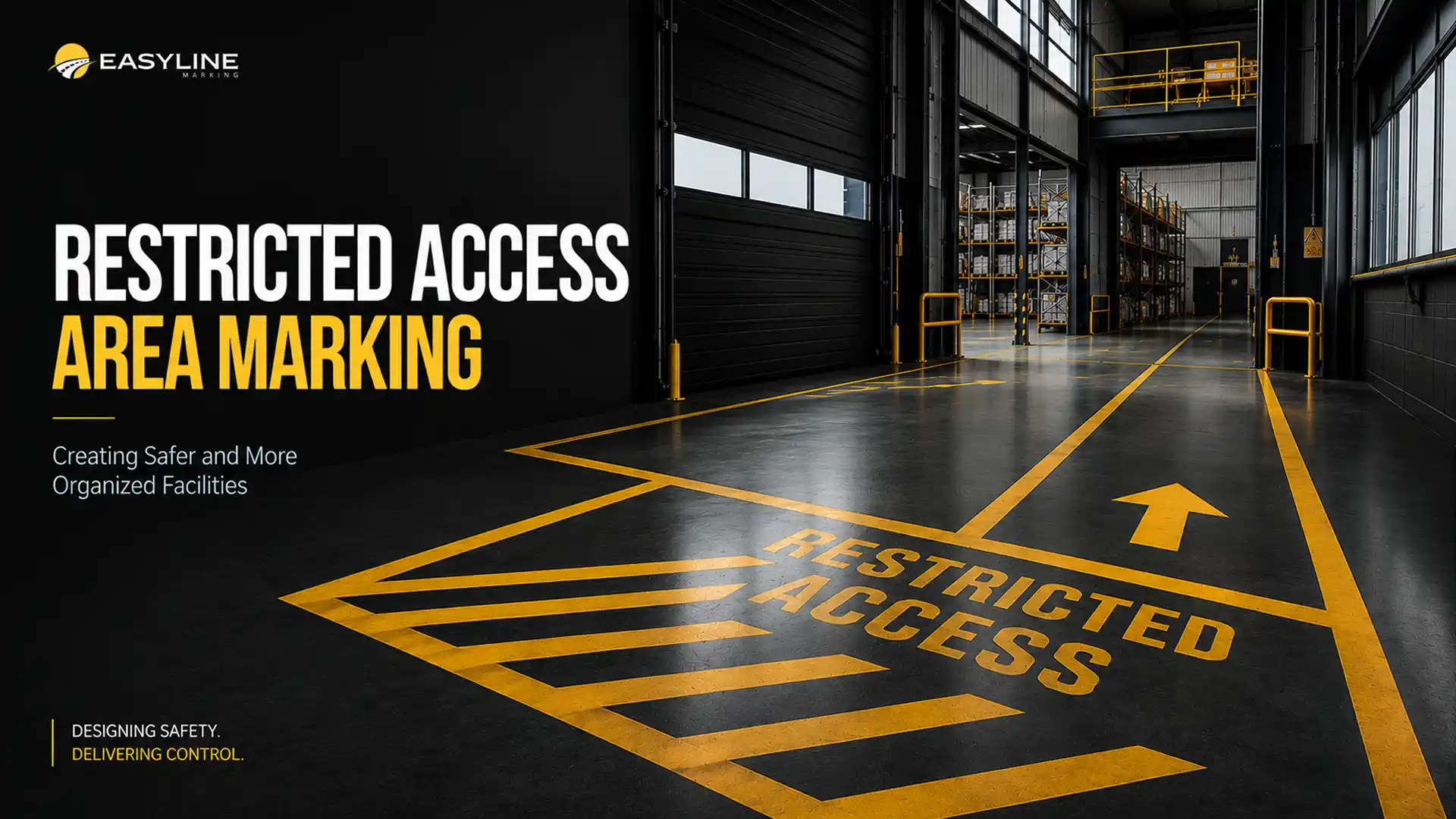
Restricted Access Area Marking helps identify areas where entry is limited to authorized personnel, approved vehicles, or specific operational activities. These markings create visible boundaries that improve workplace safety, support access control procedures, reduce confusion, and help facilities maintain organized operations.
Why Access Control Starts on the Floor
Most facility managers invest in signs, policies, and training programs to keep employees and visitors safe. However, one of the most effective forms of communication is often the simplest: clear visual markings.
People moving through a warehouse, distribution centre, manufacturing plant, or commercial facility make decisions quickly. Floor markings provide immediate visual guidance that helps them recognize where they can and cannot go.
This is where Restricted Access Area Marking plays an important role. Rather than relying solely on written instructions, facilities can establish highly visible boundaries that communicate restrictions instantly.
Understanding Restricted Areas
Restricted areas are spaces where access is intentionally limited because of safety, operational, security, or compliance requirements.
These zones may include:
Equipment Rooms
Mechanical and electrical rooms often contain systems that require trained personnel.
Forklift Traffic Zones
Many warehouses separate equipment travel routes from pedestrian pathways.
Loading Dock Areas
These locations involve vehicle movement, material handling, and elevated fall risks.
Hazardous Storage Areas
Certain materials require controlled access and clear identification.
Production Spaces
Manufacturing environments frequently contain equipment and processes that require specialized training.
Proper Restricted Access Area Marking helps reinforce these boundaries and supports safer facility operations.
The Real Problem: Unintentional Entry
In many facilities, unauthorized access is not the result of employees deliberately ignoring rules.
More often, people simply fail to recognize that they have entered a controlled area.
Visitors, contractors, temporary workers, and new employees may be unfamiliar with the facility layout. Without clear visual indicators, they can easily move into areas they should avoid.
Facility audits frequently reveal that restricted zones are identified by a small wall sign but lack any floor-level visual warning. This creates unnecessary risk and confusion.
Visible floor markings help eliminate uncertainty and encourage people to stop before crossing into a controlled space.
Benefits beyond Safety
Many organizations initially implement restricted area markings for safety reasons, but the benefits often extend much further.
Better Traffic Management
Clearly defined boundaries help organize vehicle and pedestrian movement.
Improved Operational Efficiency
Employees spend less time navigating unclear facility layouts.
Stronger Security Practices
Restricted areas become easier to identify and enforce.
Reduced Liability Exposure
Visible boundaries demonstrate a proactive approach to risk management.
Enhanced Facility Appearance
Organized markings contribute to a more professional and well-managed environment.
For busy industrial facilities, Restricted Access Area Marking becomes part of a broader operational strategy rather than a standalone safety measure.
Ontario Facilities Face Unique Challenges
Commercial and industrial facilities throughout Ontario often operate in demanding environments.
Warehouses experience constant forklift traffic. Manufacturing plants undergo layout changes. Distribution centers handle high volumes of employee and contractor movement.
In larger facilities across Toronto and the GTA, maintaining clear visual communication is particularly important because of the number of people moving through the site daily.
When markings fade or become inconsistent, access control measures lose effectiveness.
Routine inspections help ensure restricted zones remain visible and easy to understand.
Common Mistakes Facility Managers Make
Depending Only on Signage
Signs are important, but they are often overlooked in busy environments.
Allowing Markings to Fade
Worn markings gradually lose their ability to communicate boundaries.
Using Inconsistent Layouts
Different styles and colours can create confusion throughout a facility.
Ignoring Facility Changes
When operations evolve, markings should be updated to reflect new workflows.
Failing to Define Boundaries Clearly
Many facilities identify restricted areas verbally but never establish visible floor-level controls.
These issues reduce the effectiveness of Restricted Access Area Marking and make compliance more difficult.
Best Practices for Long-Term Success
Facilities that achieve the best results typically follow a structured approach.
Establish Consistent Standards
Use uniform layouts and marking styles throughout the property.
Make Boundaries Obvious
Restricted zones should be recognizable from a distance.
Integrate Markings with Signage
Both tools work together to reinforce access restrictions.
Review Markings Regularly
Inspections should be part of routine facility maintenance programs.
Align Markings with Operational Needs
Access control boundaries should reflect current workflows and facility requirements.
When properly planned, Restricted Access Area Marking becomes an effective communication tool that supports both safety and productivity.
Property Manager and Facility Manager Perspective
Property managers and facility managers are often responsible for balancing safety requirements with operational efficiency.
Clearly identified restricted zones help reduce confusion, support contractor management, improve visitor control, and strengthen workplace safety initiatives.
Whether managing a warehouse, industrial facility, commercial complex, or logistics centre, establishing visible access boundaries is one of the simplest ways to improve day-to-day operations.
Conclusion
Restricted areas exist to protect people, equipment, and operations. Without clear visual boundaries, even well-designed safety procedures can become less effective. Restricted Access Area Marking helps facilities communicate access limitations quickly, reduce unauthorized entry, improve organization, and support safer workplaces. For commercial and industrial properties throughout Ontario, it remains one of the most practical tools for strengthening operational control.
FAQ
What is restricted access area marking?
It is the use of floor markings and visual boundaries to identify areas where access is limited to authorized personnel or approved activities.
Why are restricted areas marked?
They help improve safety, reduce unauthorized entry, and support facility organization.
Where are restricted area markings commonly used?
Warehouses, manufacturing facilities, loading docks, equipment rooms, electrical rooms, and secure storage areas.
Do floor markings replace safety signs?
No. Floor markings and signage work together to create stronger visual communication.
How often should restricted area markings be inspected?
Most facilities should inspect markings regularly and refresh them whenever visibility begins to decline.
Contact Easy Line Marking
Need professional restricted area marking, warehouse floor marking, safety zone marking, or industrial facility marking services?
Phone: (438) 725-7842
Email: info@easylinemarking.ca
Contact Easy Line Marking to discuss your facility's safety, traffic management, and access control marking requirements.
Ready to Get Started?
Request a free, no-obligation quote and our team will get back to you within one business day.
- Free on-site assessment — no obligation
- Fast response — usually within 1 business day
- Work scheduled around your business hours