
Industrial Marking
Which floor markings still match the way your facility operates today?
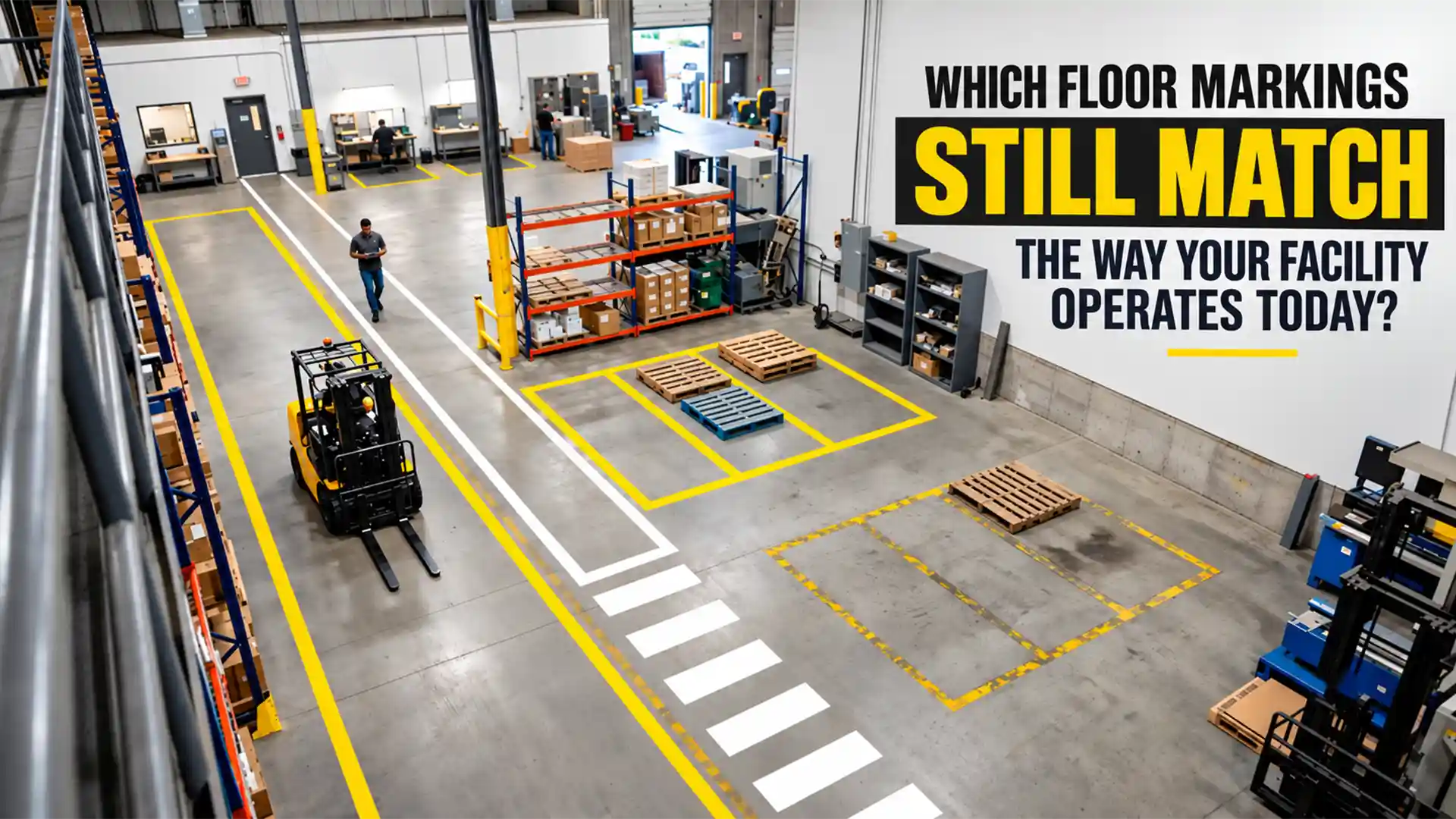
Industrial facilities rarely remain exactly as they were when their floor markings were first established. Storage arrangements change, equipment moves, staging requirements develop, and workstations may be reorganized as operations evolve. The lines on the floor can remain long after those changes take place.
For facility managers considering Industrial Floor Marking in Burlington, this creates a practical question: does the marked floor still represent the facility you operate today? Easy Line Marking works with private industrial and warehouse properties where existing layouts can be repainted or new layouts established according to current operational requirements.
Begin with the areas that have changed
Before focusing on faded paint, think about what has physically or operationally changed within the facility.
Perhaps pallet staging has moved closer to shipping and receiving. Storage aisles may have been reorganized, equipment could now be parked elsewhere, or workstations may occupy different sections of the floor.
These changes matter because a line does not have to be faded to become outdated.
When reviewing Industrial Floor Marking in Burlington, compare the existing markings with the activities currently taking place around them. A clearly visible boundary that represents an old arrangement may need more attention than a faded line that is still correctly positioned.
Check whether designated work areas are still accurate
Look separately at the areas assigned to specific activities.
Storage aisles, pallet staging, workstations, equipment parking, loading docks, and shipping or receiving areas may all have defined purposes within a facility. The important question is whether the floor still communicates those purposes accurately.
For example, an old staging boundary may remain even though pallets are now staged somewhere else. An equipment zone could be clearly painted while the equipment itself has been permanently relocated.
Seeing Industrial Floor Marking in Action can also help illustrate how designated operational areas can be visually defined on a facility floor.
For Industrial Floor Marking in Burlington, reviewing these functional areas individually can help determine which markings remain useful and which ones no longer correspond with current operations.
Follow today's forklift and pedestrian movement
Changes to fixed operational areas can influence movement throughout a facility.
If storage, equipment, or staging locations have moved, employees and forklifts may also be following different routes. Look at the pedestrian walkways and forklift travel lanes currently marked on the floor and compare them with everyday movement.
Are employees still using the intended walkway? Does the forklift lane correspond with the route equipment actually needs to travel?
The purpose is not to redesign these routes yourself. Instead, you are identifying areas where the marked layout and real facility use may no longer match.
This information can provide useful context when planning Industrial Floor Marking in Burlington with Easy Line Marking.
Notice the markings experienced employees ignore
Long-term employees often understand a facility through experience rather than relying entirely on painted markings.
They may know that an old storage boundary is no longer relevant. Perhaps a particular zone stopped being used months ago, or equipment is routinely parked somewhere other than the area originally marked for it.
Experienced employees can adapt to these changes without much difficulty. Someone unfamiliar with the facility does not have the same background knowledge.
If workers regularly disregard a particular marking because its original purpose no longer exists, that is worth reviewing.
When considering Industrial Floor Marking in Burlington, these ignored markings can reveal places where the floor is communicating an older operational arrangement.
Know the difference between faded and outdated
A faded marking and an outdated marking represent different problems.
If a pedestrian walkway, forklift lane, staging area, or equipment zone remains correctly positioned but has become difficult to distinguish, repainting the established layout may be appropriate.
If a clearly visible marking represents an area that has changed function, repainting it in exactly the same position may simply make outdated information more prominent.
This distinction is important when planning industrial Line Painting.
Easy Line Marking provides both repainting and new layout work. Before starting Industrial Floor Marking in Burlington, property and facility managers can identify which parts of the existing arrangement should remain and which areas need to be reconsidered.
Leave open floor space open when appropriate
Not every unused section of an industrial floor needs another painted box, lane, boundary, or hatched area.
Each marking should relate to a genuine operational requirement.
Depending on the facility, relevant markings can include forklift travel lanes, pedestrian walkways, storage aisles, pallet staging, loading docks, shipping and receiving areas, hazard zones, workstations, emergency exits, equipment parking, and other defined operational areas.
That does not mean every facility needs all of them.
When reviewing Industrial Floor Marking in Burlington, consider what information a proposed marking would communicate. If an open area has no designated function that needs to be identified, leaving the floor unmarked may be appropriate.
Ask employees what has changed in everyday use
Facility drawings and existing markings provide useful information, but employees who work in particular areas every day may notice operational changes that are less obvious during a short walkthrough.
Ask where staging currently takes place. Find out whether storage arrangements have shifted. Check whether equipment parking has changed and whether any existing marked areas have effectively stopped serving their original purpose.
This is not about asking employees to design the new layout. It is about understanding the facility as it actually operates.
You can also see warehouse floor markings being applied to better understand how planned operational areas become visible boundaries on the floor.
Combining everyday observations with a professional assessment can help create a clearer picture of what should remain, change, or be repainted.
Build the project around the facility you have now
Once you understand what has changed, you can describe your requirements more clearly.
Useful information for Easy Line Marking can include the property address, photographs, layout drawings if available, surface type, dimensions or quantities, areas requiring markings, whether the project involves a new layout or repainting, and the preferred timeline.
An experienced estimator or project manager can assess the layout, traffic flow, surface condition, accessibility and safety requirements, take measurements, and discuss operational needs.
For active warehouse environments, phased work and evening or weekend scheduling may also be considered where applicable.
This allows Industrial Floor Marking in Burlington to be planned around current facility requirements rather than automatically reproducing an older arrangement.
Make the floor reflect today's operations
Your facility floor should not describe how the building worked several operational changes ago.
Review what has moved. Look at staging, storage, workstations, equipment areas, pedestrian walkways, and forklift lanes. Pay attention to markings employees have learned to ignore, and distinguish between paint that is simply faded and markings that no longer represent current activities.
For facility managers planning Industrial Floor Marking in Burlington, Easy Line Marking can assess existing conditions and determine an appropriate scope for repainting or new layout work based on the property's current operational requirements.
Contact Easy Line Marking to discuss your industrial floor marking requirements.
Phone: +1 437-577-3547
Email: info@easylinemarking.ca
Ready to Get Started?
Request a free, no-obligation quote and our team will get back to you within one business day.
- Free on-site assessment — no obligation
- Fast response — usually within 1 business day
- Work scheduled around your business hours


