
Pavement Marking
Are your pavement markings still clear from a driver's perspective?
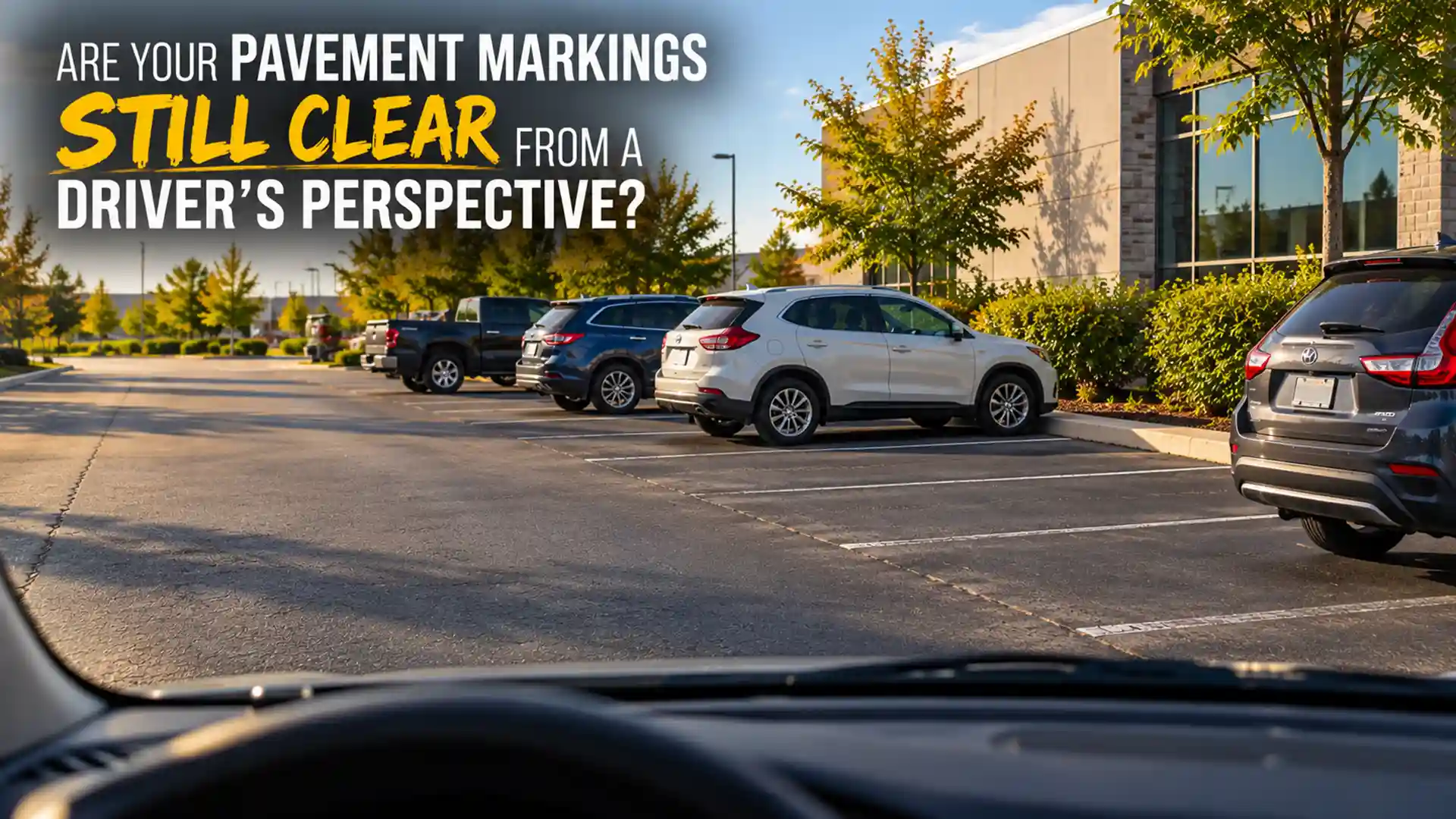
Pavement markings should be evaluated from the positions where drivers actually need to recognize them. A directional arrow may appear visible during a walking inspection but become difficult to interpret when approaching a junction, turning into a parking aisle, or passing parked vehicles. Checking these decision points helps determine whether repainting, layout adjustments, or better wayfinding is needed.
For property managers considering Pavement Marking in Richmond Hill, the objective is not simply to make every line brighter. It is to understand whether the existing markings communicate the intended movement clearly. Easy Line Marking provides repainting and new layout services for private commercial properties.
Why is a walking inspection not always enough?
Walking through a parking lot provides useful information about paint wear, damaged boundaries, and missing markings. However, it does not always reveal what drivers experience while moving through the property.
A marking viewed from directly above may be easy to recognize. The same marking can appear less obvious from inside a vehicle, especially when approaching from an angle.
Parked vehicles, landscaped islands, curbs, and changes in pavement direction can also affect visibility.
During an inspection, observe the property from normal driving approaches. Identify where drivers must choose a direction, enter a parking aisle, or stop before continuing.
The important question is whether the marking provides useful information before the decision must be made.
Where do drivers make important navigation decisions?
Commercial parking areas contain several locations where drivers need clear guidance.
These commonly include property entrances, internal junctions, parking aisle connections, and areas where vehicle routes change direction.
For example, a driver entering a retail plaza may encounter two similar-looking aisles around a landscaped island.
Even if the pavement markings remain visible, the correct route may not be immediately obvious.
A directional sign positioned beyond the junction may provide information too late to help with the decision.
In this situation, repainting the existing arrows may improve their appearance without resolving the underlying navigation problem.
Property managers should assess whether markings, signs, and physical routes communicate consistent information at each decision point.
Can parked vehicles hide important markings?
An empty parking lot can look considerably different from the same property during business hours.
Vehicles occupying stalls may obscure parts of directional arrows, parking boundaries, or nearby pavement instructions.
Large delivery vehicles can also affect visibility around loading areas and internal access routes.
For this reason, inspect the property when normal parking activity is taking place.
Observe whether drivers can recognize the intended travel aisle before reaching parked vehicles.
Also consider whether turning movements make certain markings difficult to see.
Not every visibility problem requires additional paint. Sometimes the existing layout, vehicle positioning, or location of directional information needs review.
The goal is to identify the actual cause before selecting a marking solution.
Do pavement markings match the property's signs?
Pavement Markings work alongside directional signs, curbs, entrances, and the overall property layout.
When these elements communicate different information, drivers may struggle even if the painted lines remain clear.
Consider a hypothetical Richmond Hill commercial plaza where a sign directing visitors toward customer parking is positioned beyond a landscaped island.
Two drive aisles approach the island, but the sign cannot be read until the driver has nearly reached the junction.
Repainting the pavement arrows alone may not solve the problem.
The property manager should review the sign location, intended traffic movement, and existing markings together.
Where sign placement or physical layout is the main issue, those concerns may require separate solutions beyond line painting.
Which markings should be inspected first?
Start with markings that influence vehicle movement and designated use.
Directional arrows and stop bars deserve attention where drivers need to recognize instructions before entering a junction or continuing along a travel aisle.
Parking stall boundaries should be reviewed where their condition makes individual spaces difficult to identify.
Accessible parking markings and associated access aisles should also be assessed according to applicable requirements.
Pedestrian crossings should be inspected where they connect established walking routes across vehicle travel areas.
A crossing should not be added merely because an entrance is nearby.
For Pavement Marking in Richmond Hill, prioritizing functional markings helps property managers define necessary work without assuming every open section of asphalt requires paint.
When is repainting the correct solution?
Repainting is generally appropriate when the existing marking remains correctly positioned but has deteriorated through wear.
For example, if a directional arrow still indicates the intended route but its paint has become difficult to recognize, repainting may restore its visibility.
However, repainting is not always sufficient when the marking communicates outdated information.
A parking lot may have changed its loading arrangements, entrance circulation, or designated parking areas.
In those circumstances, the existing layout should be reviewed before the old markings are restored.
Easy Line Marking can assess existing pavement markings and discuss whether repainting or new layout work is appropriate.
The proposed work should address the identified problem rather than simply reproduce every existing line.
What should a contractor assess before painting?
A useful site assessment considers more than paint visibility.
The contractor should understand the marking requirements, existing layout, pavement condition, and operational restrictions.
Surface preparation is also important. Dirt, loose debris, moisture, and pavement deterioration can affect the suitability of the surface for painting.
Easy Line Marking uses waterborne and solvent-based traffic paints for suitable projects.
The appropriate material depends on surface and application conditions.
Before approving a quotation, confirm which markings are included, whether any layout changes are proposed, and what preparation is required.
If outdated markings could conflict with a revised arrangement, ask how they will be addressed.
The quotation should also identify relevant scheduling and access requirements.
How can property managers document inspection findings?
A simple inspection record can make the quotation process more efficient.
Photograph each problem from both a nearby position and the direction a driver normally approaches.
Record the location, existing marking, and reason it may be unclear.
For example, instead of writing "arrow needs painting," describe whether the arrow is faded, partially hidden, incorrectly positioned, or inconsistent with nearby directional information.
A useful record may include:
- Property entrance and affected parking aisle
- Photograph from the driver's approach
- Existing marking condition
- Nearby signs or physical obstructions
- Whether repainting or layout review appears necessary
- Any access restrictions affecting the work
These details help distinguish paint maintenance from broader property navigation concerns.
How should the work be scheduled?
Commercial properties may need to maintain customer, employee, tenant, or delivery access during painting.
Before scheduling, identify which parking sections and travel aisles can be temporarily restricted.
Phased work may be practical when separate areas can be completed without blocking essential routes.
However, the available options depend on the actual property layout.
Reopening conditions also vary according to the paint, surface, weather, and application requirements.
Ask the contractor to explain the proposed schedule and how affected areas will return to use.
Avoid assuming that every section can reopen after the same fixed period.
Make pavement marking decisions based on actual visibility
Effective pavement markings must communicate their purpose where drivers need the information.
A walking inspection can identify worn paint, but reviewing the property from a driver's perspective may reveal problems involving parked vehicles, confusing junctions, signs, or outdated layouts.
Before arranging Pavement Marking in Richmond Hill, identify whether the issue requires repainting, repositioning existing markings, or a broader review of property wayfinding.
Easy Line Marking provides pavement marking repainting and new layout services for private commercial properties in Richmond Hill.
Contact Easy Line Marking to discuss your property's marking requirements and request a quote.
Phone: (437) 577-3547
Email: info@easylinemarking.ca
Ready to Get Started?
Request a free, no-obligation quote and our team will get back to you within one business day.
- Free on-site assessment — no obligation
- Fast response — usually within 1 business day
- Work scheduled around your business hours


