
Pavement Marking
Which commercial pavement markings should you repaint first?
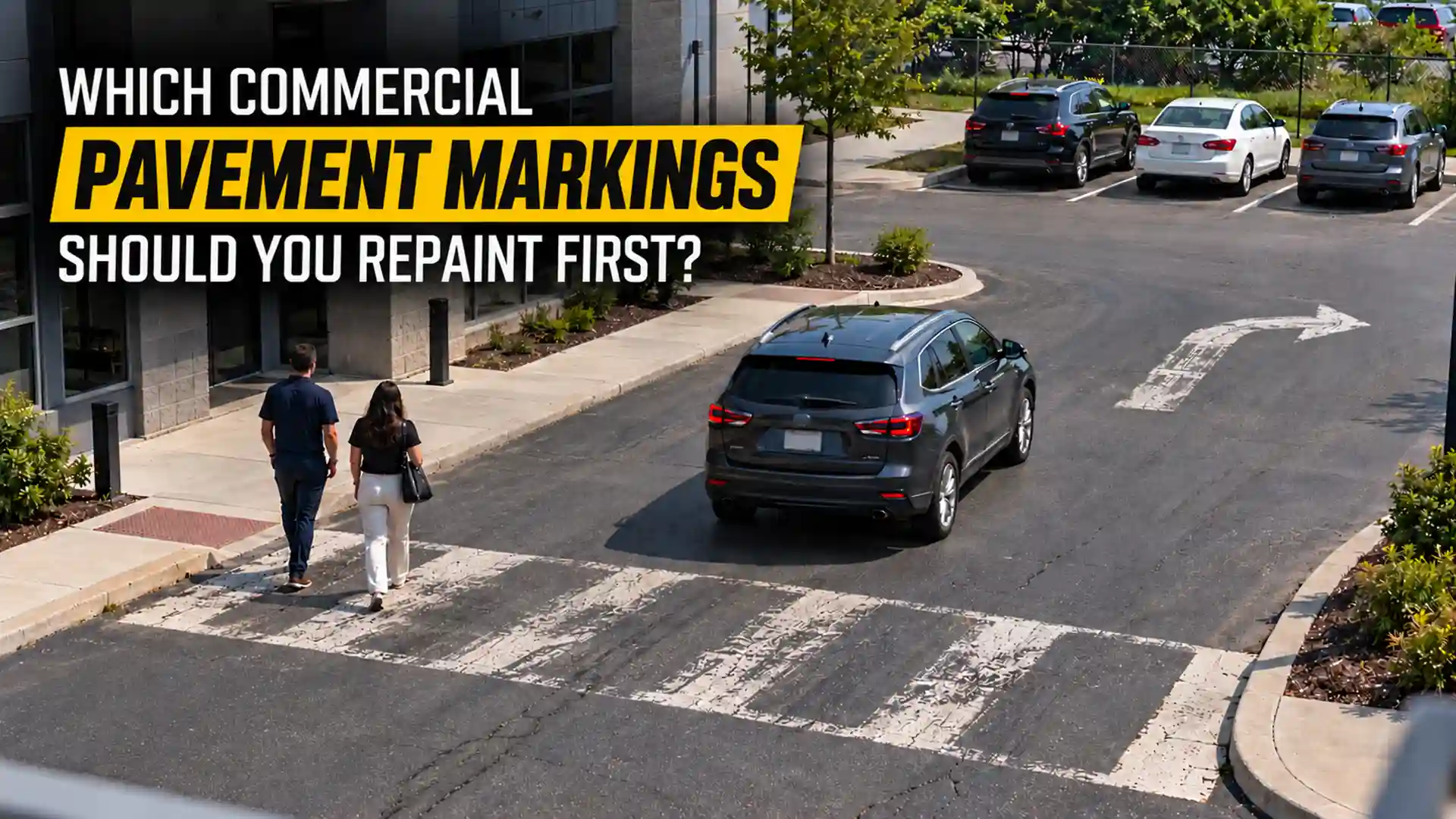
Repaint commercial pavement markings first where faded or missing lines create the greatest uncertainty for drivers and pedestrians. Prioritize critical access routes, designated parking areas, directional markings, and locations where vehicles and pedestrians interact. Then assess ordinary parking stalls and lower-use sections according to their condition and the property's operational requirements.
For property managers planning Commercial Line Painting in Vaughan, the goal is to identify which markings need immediate attention and which can reasonably be included in a later maintenance phase. Easy Line Marking provides repainting and new layout services for private commercial properties.
How do you identify which markings need attention first?
Start by inspecting the parking lot during normal operating conditions.
A marking may look reasonably visible when the property is empty but become difficult to recognize when vehicles occupy surrounding spaces.
Walk through the property and identify markings that are faded, incomplete, or no longer serving their intended purpose.
Consider three practical questions:
- Visibility: Can drivers and pedestrians recognize the marking clearly?
- Function: Does the marking communicate an important movement, boundary, or designated use?
- Location: Would an unclear marking create confusion in an area with regular vehicle or pedestrian activity?
A faded directional arrow near a busy entrance may deserve attention before a lightly worn parking stall boundary in a low-use section.
However, priority should depend on the actual site conditions rather than a fixed ranking that applies to every property.
Which entrance and directional markings should be prioritized?
Entrances, exits, and internal travel aisles are useful starting points because they guide how vehicles move through a commercial property.
Inspect directional arrows, stop bars, and other markings that help drivers understand the intended arrangement.
For example, a commercial plaza may have clearly visible parking stalls but faded arrows near a shared entrance.
Repainting every stall would not necessarily address the most immediate issue.
Instead, the property manager should review the entrance arrangement and determine which markings need attention.
Also check whether existing arrows still match the intended traffic routes.
If the property layout has changed, repainting an outdated directional marking may reinforce an unsuitable arrangement.
Easy Line Marking can review existing markings and discuss whether repainting or layout adjustments are appropriate.
When should pedestrian markings receive attention?
Pedestrian markings should be reviewed where people must cross vehicle travel areas to reach entrances, sidewalks, or other designated walking routes.
For example, a crosswalk connecting a parking area to a separate pedestrian walkway may be important where a drive aisle lies between them.
If that crossing is faded, its visibility should be assessed as part of the maintenance review.
However, not every building entrance requires a painted crosswalk.
A crosswalk should connect meaningful pedestrian routes rather than be added simply to fill an unmarked section of pavement.
Before repainting, confirm that the existing crossing remains correctly positioned and that it connects the intended pedestrian paths.
Where pedestrian movement has changed, review the arrangement before restoring the previous markings.
What about accessible parking and loading areas?
Designated parking and loading areas should be reviewed separately from ordinary parking stalls because they serve specific functions.
Accessible parking spaces may require clearly identifiable boundaries, symbols, and associated access aisles.
If these markings have deteriorated, the property manager should review their condition and the applicable requirements.
Do not assume that repainting a symbol alone addresses every accessibility consideration.
Similarly, loading areas should be checked to determine whether their boundaries and intended use remain clear.
For properties with regular deliveries, poorly defined loading spaces may create uncertainty about where vehicles should stop.
Where accessibility, fire route, or other regulatory requirements apply, confirm the relevant standards with the appropriate authority or qualified professional.
A limited maintenance budget does not remove applicable legal obligations.
Can you repaint only the most affected sections?
Yes. Partial repainting can be practical when certain markings have deteriorated while the remaining layout is still suitable.
Consider a hypothetical Vaughan retail plaza where directional arrows near the entrance are faded, but most parking stall boundaries remain visible.
The property manager could request an assessment of the affected entrance area rather than automatically arranging a complete repaint.
However, partial repainting should not leave important connected markings incomplete.
For example, repainting an arrow without reviewing the adjoining travel aisle may overlook other markings needed to communicate the intended movement.
When planning Commercial Line Painting in Vaughan, ask whether the proposed work covers the complete functional area.
A smaller project should still produce a coherent result.
How should you plan line painting with a limited budget?
Begin by separating markings that require prompt attention from those that remain functional but may need future maintenance.
Create a simple property maintenance record identifying the location, condition, and purpose of each affected marking.
Then group the work according to operational importance.
- | Priority consideration | What to review
- | Essential access | Entrances, exits, and required access routes
- | Designated areas | Accessible spaces, loading areas, and other specified zones
- | Vehicle guidance | Directional arrows, stop bars, and travel aisle markings
- | Pedestrian movement | Existing crossings connecting actual walking routes
- | General parking | Stall boundaries and parking row markings
- | Future maintenance | Lower-wear areas that remain clear and functional
This is a planning framework, not a substitute for applicable safety or accessibility requirements.
If several sections require attention, request quotations that clearly distinguish immediate work from optional additional repainting.
That makes it easier to understand the cost of each proposed phase.
What factors affect commercial line painting costs?
The cost of commercial line painting depends on the marking scope, surface condition, paint selection, preparation, and scheduling requirements.
Repainting existing lines may require different work from establishing a new layout.
A project involving parking stalls, directional arrows, accessible parking markings, and loading areas will also have different requirements from a project limited to standard stall boundaries.
Other considerations include whether the pavement needs cleaning, whether existing markings require treatment, and whether vehicles must be moved.
Easy Line Marking uses waterborne traffic paint and solvent-based traffic paint for suitable projects.
The appropriate material depends on the pavement and application conditions.
When reviewing a quotation, confirm the included markings, preparation, proposed materials, and any excluded work.
Comparing clearly defined scopes is more useful than comparing total prices alone.
How can painting be scheduled without closing the entire property?
Commercial properties often need to maintain customer, employee, tenant, or delivery access during maintenance.
Depending on the layout, painting may be divided into sections so that some parking remains available.
For example, an office property could discuss scheduling lower-use parking rows separately from areas needed during regular operating hours.
However, phased work is not always practical.
If a drive aisle provides the only access to several parking sections, restricting that aisle may affect the entire arrangement.
Before confirming the schedule, identify which spaces must be cleared, which entrances must remain available, and how affected users will be notified.
Reopening times depend on the paint and actual application conditions.
Avoid assuming that every painted section can reopen after a fixed period.
How do you monitor markings after repainting?
Once the project is complete, record which areas were painted and the date of the work.
Keep photographs of the completed markings and any layout changes.
These records can help property managers compare marking conditions during future inspections.
Pay attention to areas experiencing frequent vehicle turning, loading activity, or concentrated traffic.
Markings may deteriorate at different rates across the same property.
A section that receives regular heavy vehicle activity may need attention before a lightly used parking row.
Reviewing conditions periodically allows future maintenance decisions to reflect actual wear rather than relying on a fixed repainting interval.
What should you include when requesting a quote?
Provide the property address, recent photographs, approximate parking dimensions, and details of the markings requiring attention.
Identify which areas you believe should be prioritized and explain any operational concerns.
If the property has planned pavement repairs, tenant access restrictions, or delivery schedules, mention them before the quotation is prepared.
Also clarify whether you want to repaint existing markings or review changes to the layout.
For Commercial Line Painting in Vaughan, this information helps establish a project scope based on the property's actual requirements.
Make commercial line painting a practical maintenance decision
Not every faded marking requires an immediate full-property repaint.
The better approach is to assess visibility, function, traffic movement, designated areas, and the condition of the existing layout.
Prioritize markings that need attention, consider partial repainting where appropriate, and document the remaining maintenance requirements.
Easy Line Marking provides commercial line painting, Parking Lot Repainting, and new layout services for private commercial properties in Vaughan.
Contact Easy Line Marking to discuss your property's marking requirements and request a quote.
Phone: (437) 577-3547
Email: info@easylinemarking.ca
Ready to Get Started?
Request a free, no-obligation quote and our team will get back to you within one business day.
- Free on-site assessment — no obligation
- Fast response — usually within 1 business day
- Work scheduled around your business hours


