
Pavement Marking
Pavement markings for private parking areas and access routes
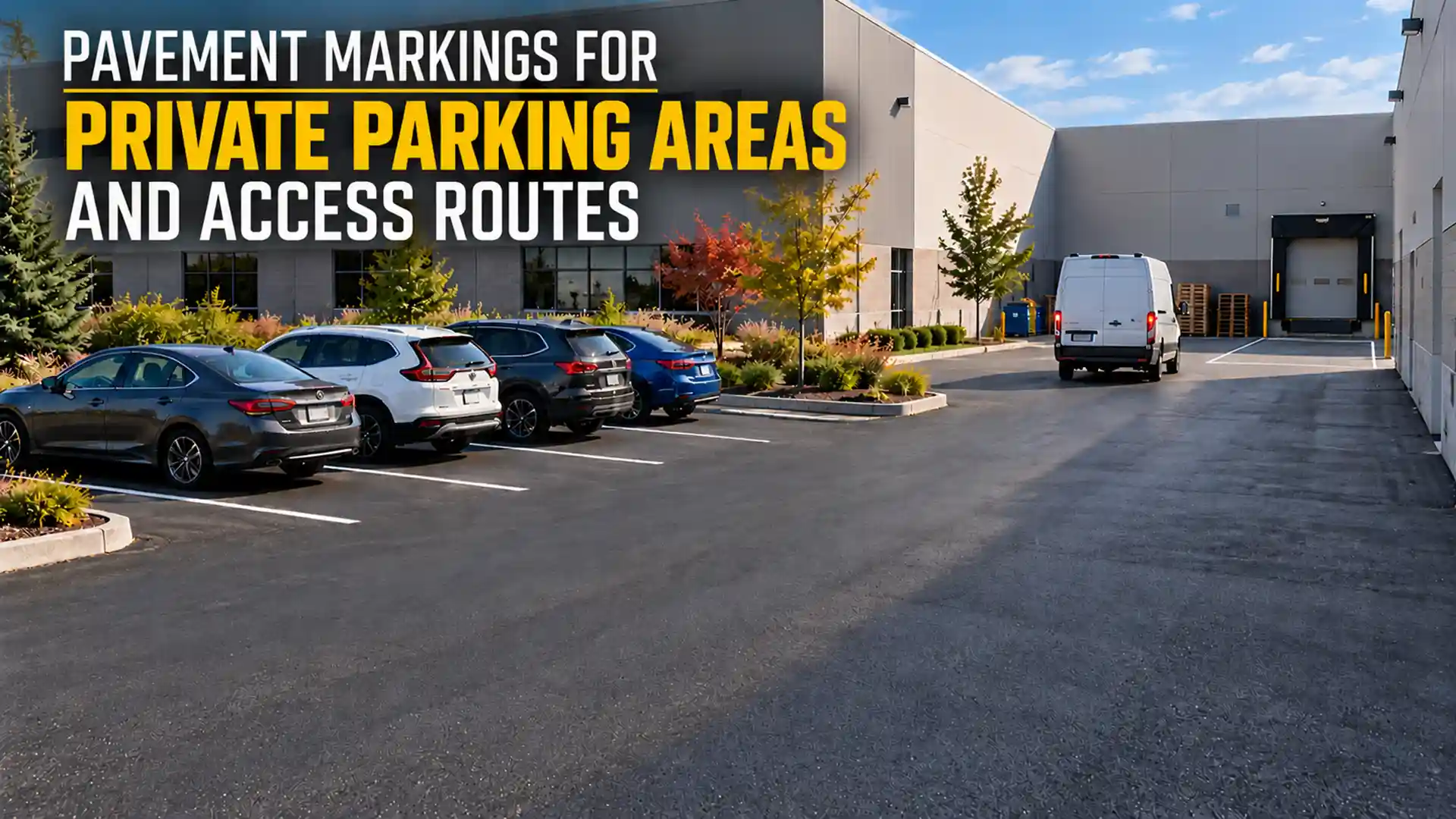
Pavement markings help people understand how to move through commercial properties by identifying vehicle routes, stopping positions, pedestrian crossings, and designated areas. Effective markings are not simply visible lines on asphalt. Their positions, shapes, and relationships should reflect the way the property actually operates.
Easy Line Marking provides professional pavement painting for private commercial and industrial properties across the Greater Toronto Area and surrounding Ontario communities. Whether existing markings need repainting or a property requires a revised arrangement, the first priority is understanding the layout, traffic movement, and purpose of each marking.
What should pavement markings communicate on a commercial property?
A commercial property may contain several different types of movement within a relatively small area. Visitors arrive through entrances, drivers navigate parking aisles, delivery vehicles access loading areas, and pedestrians travel between parked vehicles and buildings.
Each marking should help communicate an intended action or identify a designated space.
For example, a directional arrow should clarify vehicle movement at a relevant decision point. A stop bar should identify an appropriate stopping position, while a pedestrian crossing should connect established walking routes across a vehicle travel aisle.
Markings become less useful when they are placed without considering these relationships. Adding extra arrows, unnecessary painted boundaries, or crossings without meaningful connections can make the surface more confusing rather than easier to understand.
Directional arrows and vehicle movement
Directional arrows are useful where drivers need to recognize the intended direction of travel.
Common locations include internal junctions, parking aisle connections, and areas where the property layout establishes one-way movement.
However, arrows should not be added automatically to every section of pavement. Their purpose is to communicate a genuine directional requirement.
Before repainting existing arrows, property managers should consider whether the intended route remains appropriate.
A property may have changed its entrance arrangement, loading access, or parking circulation since the original markings were installed. In that situation, restoring the previous arrows could reinforce an outdated movement pattern.
The surrounding pavement layout and signs should also be considered so that drivers receive consistent information.
Stop bars and controlled movement areas
Stop bars identify positions where vehicles are expected to stop according to the property's traffic arrangement.
Their placement should correspond to actual decision points, such as internal intersections or other controlled movement areas.
A stop bar that is positioned too far from the relevant junction may be difficult for drivers to interpret. Similarly, repainting a faded bar without reviewing the surrounding arrangement may preserve an unsuitable position.
Property managers should consider sightlines, vehicle turning movements, pedestrian routes, and the intended stopping location before confirming the marking plan.
Not every internal junction requires the same treatment.
The objective is to use markings where they provide meaningful guidance while maintaining a coherent relationship with other property features.
Pedestrian crossings that connect actual walking routes
Pedestrian crossings are intended to identify locations where people move across vehicle travel areas.
A suitable crossing should connect established pedestrian routes on opposite sides of a drive aisle.
For example, a walkway serving an outer parking area may need to connect with a pedestrian path on the opposite side of a vehicle circulation route.
In that situation, the crossing location should reflect the actual movement of people.
A crosswalk should not be painted simply because a building entrance exists nearby. If the entrance already connects directly to a sidewalk without a vehicle aisle between them, an additional crossing may serve no useful purpose.
Crossing placement should also consider visibility, surrounding vehicle movements, and applicable requirements.
Accessible parking markings and access arrangements
Accessible parking areas require more than a painted accessibility symbol.
The designated parking space, associated access aisle, accessible route, signs, and surrounding arrangement must be considered together.
For property managers, the first question is whether the existing accessible parking layout remains suitable.
Repainting faded symbols may improve their visibility, but it will not correct an improperly arranged access aisle or an unsuitable connection to the building's accessible route.
Before repainting or modifying accessible parking areas, the applicable Ontario accessibility and building requirements should be reviewed with an appropriately qualified professional or relevant authority.
Markings should then reflect the confirmed arrangement.
The dedicated roadmap guide on accessible parking will address these layout considerations in greater detail without replacing this broader service page.
Fire routes, loading zones, and restricted parking areas
Commercial properties may contain areas where ordinary parking is restricted because the space has another function.
These can include designated fire routes, loading areas, and no-parking sections.
Each marking should correspond to the actual operational or approved property arrangement.
For example, a loading area should be positioned where deliveries can take place without creating unnecessary conflicts with established vehicle or pedestrian routes.
Similarly, fire route markings should reflect the applicable approved designation rather than being introduced based solely on a general assumption about emergency access.
Property managers should confirm relevant requirements with the appropriate authority before establishing or changing regulated markings.
A well-planned marking arrangement distinguishes different functions without covering the property in unnecessary paint.
How pavement markings relate to parking lot line painting
Parking stall boundaries and circulation markings often work together, but they serve different purposes.
Parking lines define where vehicles can be positioned. Directional arrows, stop bars, and crossings communicate movement and access requirements.
A commercial lot may have clearly visible parking stalls but still be difficult to navigate if its directional markings are faded or inconsistent.
Likewise, newly painted arrows cannot resolve a parking layout that no longer suits the property's operations.
For property managers who need to restore or establish individual parking spaces, our Parking Lot Line Painting service provides information about stall boundaries, parking arrangements, and repainting.
The two services should be considered together when the project involves both parking organization and internal vehicle circulation.
When should existing pavement markings be repainted?
Repainting may be appropriate when existing markings have become difficult to recognize but their positions and functions remain correct.
Common concerns include faded arrows, incomplete stop bars, worn crossing lines, and designated areas that are no longer clearly identified.
However, visibility alone should not determine the scope.
Before repainting, property managers should review whether the original marking arrangement still reflects current traffic movement.
Changes in tenant operations, delivery patterns, parking allocations, or building access can affect how a property functions.
If the existing layout remains suitable, restoring the markings may be straightforward.
Where movement patterns have changed, selected markings may need repositioning or redesign.
The objective is to restore useful guidance rather than reproduce outdated information.
What should happen before pavement painting begins?
Surface preparation is an important part of any pavement marking project.
The condition of the asphalt or concrete should be reviewed before paint is applied.
Loose debris, dirt, moisture, and deteriorated surface areas may affect the suitability of the pavement for painting.
Preparation may involve sweeping, cleaning, or other appropriate treatment depending on site conditions.
Property managers should also identify planned pavement repairs or resurfacing.
If those activities are expected soon, coordinating them before painting may help avoid repeating work unnecessarily.
The site review should consider both the surface condition and the markings being proposed.
Any repairs outside the line painting scope should be identified before the project schedule is confirmed.
Choosing the appropriate traffic paint
Easy Line Marking uses waterborne traffic paint and solvent-based traffic paint for suitable marking applications.
The appropriate choice depends on surface condition, application requirements, and environmental conditions.
Different parts of a commercial property may experience different levels of wear.
For example, an area with frequent turning movements may experience different paint wear from a lightly used access section.
The proposed paint system should therefore be considered alongside the actual site conditions.
Neither waterborne nor solvent-based traffic paint should be assumed to have a guaranteed service life across every property.
Surface preparation, traffic activity, weather exposure, and ongoing maintenance all influence marking performance.
A project quotation should identify the proposed material and relevant preparation requirements.
Planning painting work without unnecessarily disrupting access
Commercial properties often remain active while maintenance work is being arranged.
A retail plaza may need to preserve customer access, while an industrial property may have scheduled deliveries or operational restrictions.
These conditions should be discussed before work begins.
Depending on the layout, pavement painting may be organized in phases.
For example, one parking or access section may be temporarily restricted while another remains available.
However, phased work may not be practical where a single drive aisle connects several parts of the property.
Property managers should identify essential routes, affected parking spaces, and any operational periods that need special consideration.
Reopening arrangements depend on the paint system, weather, surface conditions, and application requirements.
A realistic schedule should account for those factors rather than assume a fixed reopening time.
How to assess whether your existing markings still work
An effective assessment looks at both the physical condition of the paint and the way people use the property.
Begin by observing normal vehicle and pedestrian movement.
Identify locations where drivers must make decisions, where vehicles are expected to stop, and where pedestrians cross travel aisles.
Then compare those movements with the existing markings.
Ask whether each arrow, boundary, or symbol still communicates the intended function.
Look for areas where faded paint creates uncertainty, but also consider markings that remain visible while no longer matching the current layout.
The assessment may reveal that only selected markings need repainting.
In other cases, changes to circulation or designated areas may be appropriate before new paint is applied.
What information should you provide when requesting a quotation?
A clear project brief helps establish the marking scope before work is scheduled.
Useful information includes the property address, approximate dimensions, photographs, and a description of the affected areas.
A Google Maps or satellite view can help communicate the overall layout.
Identify the markings that need attention, such as directional arrows, stop bars, pedestrian crossings, accessible parking areas, or designated loading spaces.
Explain whether the work involves repainting existing markings or introducing a revised arrangement.
If the property has delivery schedules, customer access requirements, or other operational restrictions, include those details.
The estimator or project manager can use this information to determine what should be reviewed during the site assessment.
Pavement marking services across Ontario
Easy Line Marking provides marking services for private commercial and industrial properties throughout the Greater Toronto Area and surrounding Ontario communities.
Service locations include Toronto, Mississauga, Brampton, Vaughan, Markham, Richmond Hill, Oakville, Burlington, Milton, Ajax, Pickering, Whitby, Oshawa, Newmarket, Aurora, and Caledon.
The company also serves surrounding communities, including Cobourg, Colborne, Brighton, and Grafton.
Although many properties require similar types of markings, their actual layouts and operating conditions can differ substantially.
A retail plaza with several internal parking aisles may need different directional guidance from an industrial property with a shared delivery entrance.
The marking plan should therefore reflect the individual site rather than rely on a standard arrangement for every location.
Professional pavement markings for your commercial property
Clear markings help communicate how a private commercial property is intended to function.
Whether the work involves directional arrows, pedestrian crossings, stop bars, or designated areas, each marking should have a practical purpose and correspond to the property's layout.
If existing markings are worn or the arrangement needs review, the next step is to assess the surface, circulation routes, and operational requirements.
Explore our Pavement Markings service to understand the available marking work, or contact Easy Line Marking to discuss your property's requirements.
Phone: (437) 577-3547
Email: info@easylinemarking.ca
Service area: Greater Toronto Area and surrounding Ontario communities.
Ready to Get Started?
Request a free, no-obligation quote and our team will get back to you within one business day.
- Free on-site assessment — no obligation
- Fast response — usually within 1 business day
- Work scheduled around your business hours


