
Warehouse Safety
After visiting hundreds of warehouses, these six marking lessons stand out
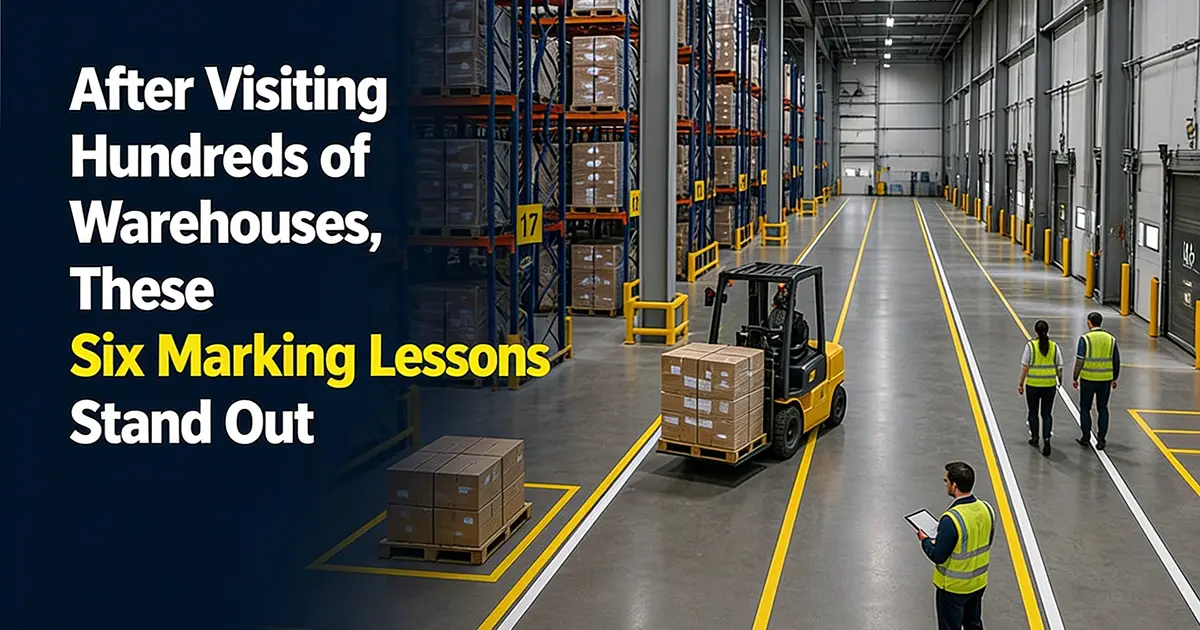
After walking through warehouses across Ontario, one observation comes up repeatedly.
The buildings are different, the industries vary, and production methods change, but many operational challenges look surprisingly similar. Forklift operators adapt to inefficient routes, storage slowly expands into travel lanes, and pedestrian walkways no longer reflect how people actually move through the facility.
These changes don't happen overnight. They develop gradually as businesses grow. By the time managers notice reduced efficiency, the warehouse has already created its own unofficial traffic system.
Easy Line Marking approaches Warehouse Line Painting as an opportunity to understand how a facility operates today rather than simply repainting yesterday's layout. The following lessons come directly from real industrial environments and continue to shape how successful marking projects are planned.
Lesson 1: Warehouses always evolve faster than their floor markings
Very few warehouses operate exactly as they did when they first opened.
Additional racking is installed, production areas expand, inventory increases, and shipping volumes grow. These operational improvements support business growth, yet floor markings often remain untouched for years.
Easy Line Marking regularly finds facilities where the paint is still visible but no longer reflects the actual workflow. Employees naturally create shortcuts, equipment follows more efficient paths, and temporary work areas gradually become permanent.
Rather than assuming the original layout is still correct, every Warehouse Line Painting project should begin by asking one simple question:
"Does the current layout still match today's operation?"
Lesson 2: Forklift operators quietly redesign the warehouse
Forklift drivers spend more time moving around a warehouse than anyone else.
Without realizing it, they often create the most efficient routes based on daily experience. If a painted lane forces unnecessary turns or slows production, operators naturally develop a better path.
Easy Line Marking has seen warehouses where equipment consistently ignored painted routes—not because employees were careless, but because the markings no longer supported real operations.
Observing equipment movement before repainting often reveals opportunities to improve efficiency without changing the building itself.
Good Warehouse Line Painting supports the way people actually work rather than expecting them to adapt to outdated layouts.
Lesson 3: New employees notice problems experienced staff stop seeing
Employees who have worked in the same warehouse for years develop instinct.
They know where forklifts usually travel, which corners require extra attention, and which storage areas have gradually expanded.
New employees don't have that experience.
Instead, they rely entirely on visual guidance during their first weeks on the job.
Easy Line Marking recommends walking through every warehouse as though it were your first day. If pedestrian routes, staging zones, loading areas, and equipment lanes are immediately obvious, the layout is probably working well.
If not, clearer markings can improve both onboarding and daily workplace organization.
Lesson 4: Storage areas always expand before anyone notices
Every warehouse experiences periods of high inventory.
Extra pallets arrive.
Temporary staging zones appear.
Overflow storage occupies unused floor space.
Eventually those temporary changes become part of normal operations.
Easy Line Marking frequently observes storage gradually extending into travel lanes or reducing turning space near loading areas. Because these changes happen slowly, they often escape attention until congestion becomes a daily issue.
Reviewing storage boundaries during Warehouse Line Painting projects helps facilities recover valuable operational space without major renovations.
Lesson 5: Fresh paint cannot solve an outdated workflow
One of the biggest misconceptions in industrial facilities is that repainting alone will improve operations.
Fresh lines certainly improve visibility.
However, if the underlying layout no longer supports production, the same operational problems usually return.
Easy Line Marking believes every marking project should begin with observation rather than assumptions.
Watching employee movement, forklift traffic, loading activity, and storage patterns often identifies opportunities to simplify operations before any paint is applied.
That planning stage frequently delivers more value than the repainting itself.
This practical approach has become one of the defining characteristics of successful Warehouse Line Painting projects.
Lesson 6: Small improvements usually outperform major redesigns
Many warehouse managers assume meaningful improvements require expensive renovations.
In reality, the opposite is often true.
Moving a pedestrian crossing a few metres, widening a forklift lane, redefining a staging area, or improving visibility at busy intersections can significantly improve traffic flow without interrupting production.
Easy Line Marking has completed projects where relatively minor layout adjustments produced noticeable improvements in organization because they aligned with the way employees already worked.
The objective isn't to redesign every warehouse.
It's to remove the small obstacles that slow operations every day.
What these lessons continue to teach us
No two warehouses operate exactly the same way.
Some prioritize rapid order fulfilment. Others focus on manufacturing, distribution, storage, or logistics. Yet every successful warehouse shares one characteristic—it is easy to understand.
Employees know where to walk.
Equipment follows predictable routes.
Materials remain inside designated areas.
Visitors can navigate the facility without constant supervision.
Through years of working with industrial facilities across Ontario, Easy Line Marking has learned that successful Warehouse Line Painting projects begin with observation, not assumptions. The best markings are those that quietly support daily operations without becoming something employees have to think about.
When floor markings reflect how a warehouse truly functions, safety improves, movement becomes more efficient, and the workplace naturally becomes easier to manage.
Contact Easy Line Marking
Easy Line Marking helps warehouses improve safety, efficiency, and traffic flow through clearly defined floor markings and operational zones.
Whether you manage a warehouse, logistics centre, manufacturing plant, or distribution facility, Easy Line Marking develops practical marking systems that support real operational workflows instead of one-size-fits-all layouts.
Phone: (437) 577-3547
Email: info@easylinemarking.ca
Ready to Get Started?
Request a free, no-obligation quote and our team will get back to you within one business day.
- Free on-site assessment — no obligation
- Fast response — usually within 1 business day
- Work scheduled around your business hours


